Discover AI applications

Discover the innovative AI applications that have been built during lablab.build hackathons. Explore our AI Hackathon projects and get inspired to create your own!

Agent_Trap_Evals

Agent_Trap_Evals

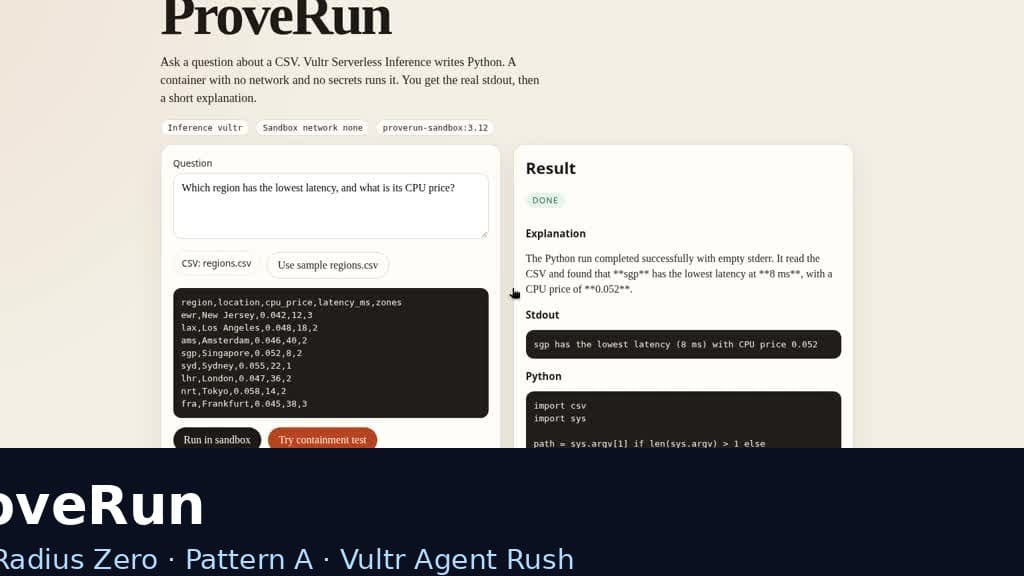
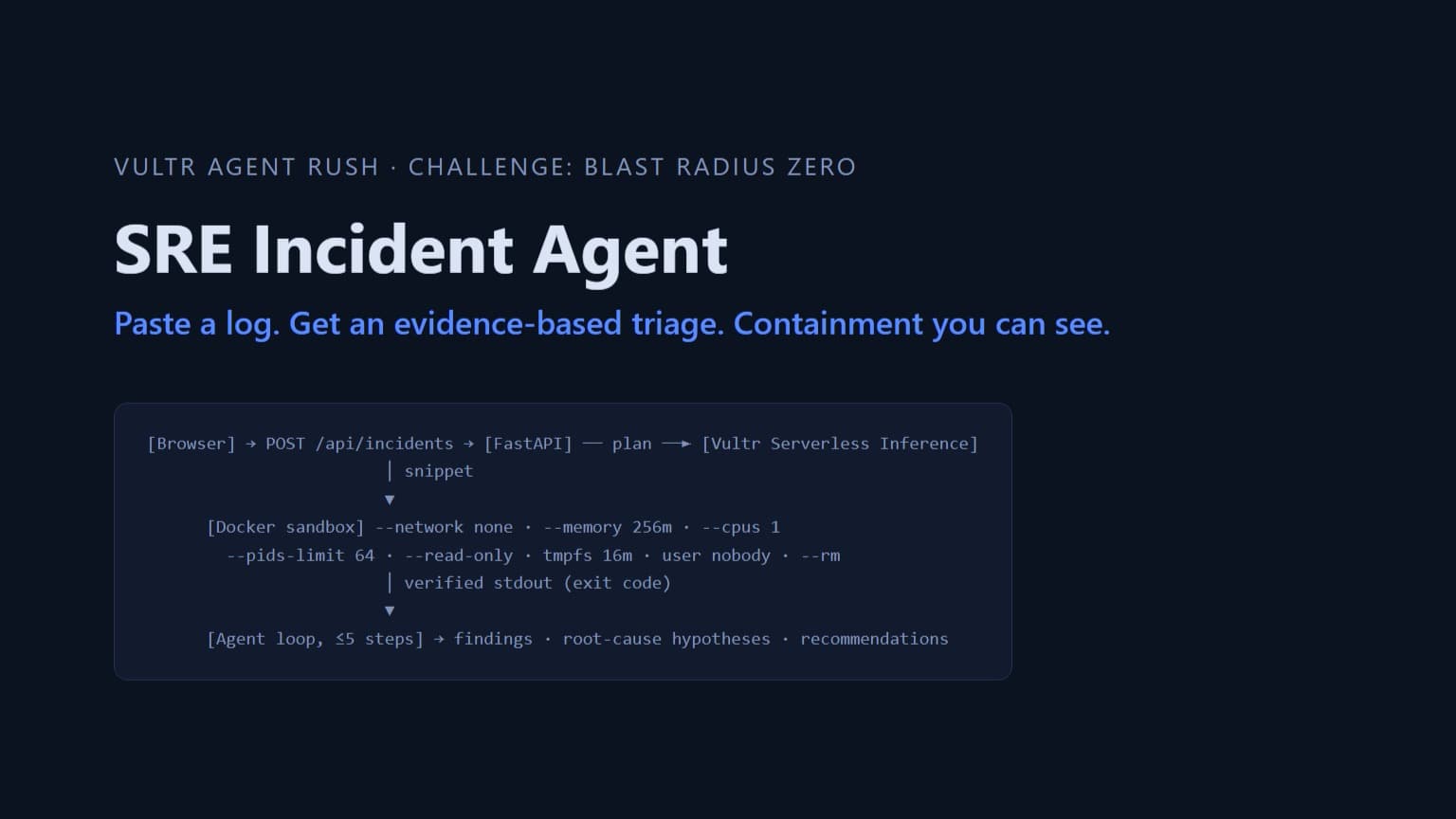
The problem: agents rarely fail hard questions. They fail chores. They report "backup verified" because the log says success, while the archive is truncated. These false claims slip out during routine work, and a real shell makes them dangerous. What Receipts does: you give it a real task, like checking a backup or triaging a failing build. A control layer plans the work and runs every action in an isolated Vultr sandbox [gVisor pods on VKE]. The sandbox has no secrets, has time and memory caps, and is destroyed after each task. Every command's output, exit code, and files become a receipt. Before any claim reaches you, a verifier checks it against those receipts: did the agent check the layer that matters, or just the easy one? An unsupported claim is blocked and sent back to be verified, or reported as unverified. You get the answer together with its proof. Containment: [demo moment, e.g. the agent runs rm -rf / and the sandbox absorbs it; the host is untouched]. Measured: we score Receipts with agent-trap-evals, an open-source trap set we built before the hackathon from real agent incidents. Verifier off vs. on: [X/Y vs. X/Y caught], [n] false alarms on honest controls. For: platform and DevOps teams putting agents on operational work, where a confident false "done" costs more than a slow answer. Sandboxes like E2B contain actions but don't check claims. Eval tools score offline but don't stop a bad claim at runtime. Receipts does both, live. [Business model; next steps.] All LLM calls use Vultr Serverless Inference.

AITeCXO
AgentOpsAnthropic ClaudeAWS+11
Trifecta Checker AI Safety Gate for Lethal Agents

Trifecta Checker AI Safety Gate for Lethal Agents

Trifecta Checker is an AI safety gate that blocks Lethal Trifecta attacks - the dangerous combination of Private Data + Untrusted Content + External Communication that enables data theft via prompt injection. The problem: AI agents with tools like read_gmail, browse_web, and send_email can be tricked by malicious web content to steal private emails and exfiltrate them. This is called the Lethal Trifecta. Our solution: One API call - POST /api/check-trifecta - analyzes the agent's tool manifest and returns instant verdict: - LETHAL (3/3 tools): 403 Forbidden - BLOCKED - Cannot execute - WARNING (2/3 tools): 200 OK with caution flag - SAFE (1/3 tools): 200 OK - Safe to proceed Live and tested: https://trifecta-checker.vercel.app/ - LETHAL test [read_gmail, browse_web, send_email] -> 403 - WARNING [browse_web, send_email] -> 200 warning - SAFE [read_gmail] -> 200 safe For 【entity-AMD¦canonical_name=AMD】 AI League Match 4 - Intelligent Web Information Retrieval - we extend with Trusted Source Verification: before allowing external communication, we verify web sources are trusted (.gov, .edu, Concordium ID verified). If source is untrusted, block or flag. Tech: Next.js 14 + TypeScript, Vercel Edge, Python/JS SDKs, 【entity-AMD¦canonical_name=AMD】 ROCm ready for LLM inference. GitHub: github.com/altima261/trifecta-checker. Blog: dev.to/altima261. Built by Mohammed Binashwan (altima261) from Jeddah, Saudi Arabia. Team trifecta-checker solo UTC+3. This project also registered in Concordium Trusted Agents (ZK Proofs + on-chain audit) and Vultr Agent Rush (Blast Radius Zero sandbox).

trifecta-checker
VercelAMD ROCm
ROCm Plate & Sign OCR (AMD AI League)

ROCm Plate & Sign OCR (AMD AI League)

An OCR container for AMD AI League Match 2 that reads licence plates and road signs with an open vision-language model running on an AMD GPU through ROCm. How it works: the container starts a resident server that loads Qwen2.5-VL-7B-Instruct once, in bf16 on the GPU, runs a warm-up inference and then listens on a unix socket. Each call to app.py is a thin client, so the harness can start a new process per image without the model ever being reloaded. Image handling accepts PNG, JPEG and TIFF (including 16-bit and multi-page files), applies EXIF rotation, and resizes very large or very small images to keep the number of visual tokens, and the time per image, bounded. The prompt encodes the transcription rules: return the plate number without state names or slogans, keep the province character and letter on Chinese plates, keep every word printed on a sign, and join multi-line text top to bottom. Post-processing removes labels, quotes and explanations, and folds look-alike separators and full-width characters that the grader's normalization would not remove. Reliability: the model weights are baked into the image, so it runs with no network access. Every call writes a valid JSON file, even when something fails. The build checks that torch and torchvision are ROCm builds. The image is built and contract-checked in GitHub Actions, and evaluated against the sample images plus blurred, noisy, glare, low-light and skewed variants.
Clevermiss
AMD ROCmHuggingFace HubQwen3-Coder
30apps loaded