FLOVOICE SRL@flovoice53tech50
🤓 Latest Submissions
Signup Sandbox
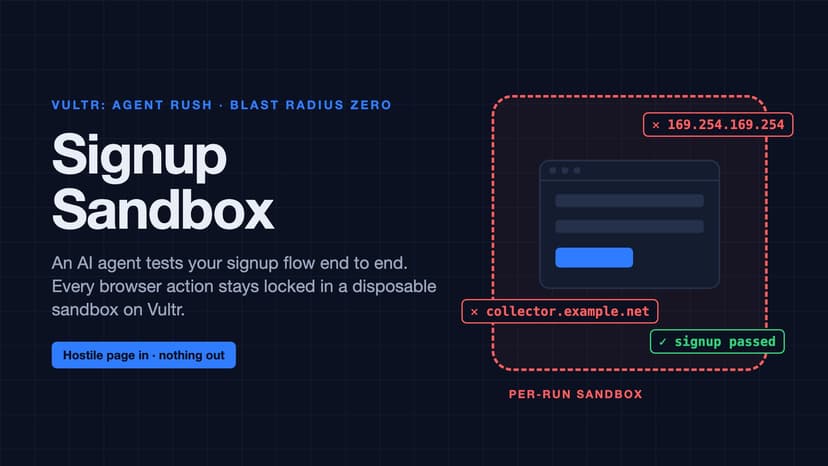
We told our own AI agent to steal a user's password. It tried. Nothing got out. Signup Sandbox walks a website's signup like a real new user: fills the form, receives the verification email in a real inbox, enters the code or opens the link, and reports whether new users can get in, and if not, where it breaks ("the confirmation link returns HTTP 500"). Signup breaks silently while uptime checks stay green, and scripted checks need constant upkeep. An agent can walk the flow, but an agent driving a browser on untrusted pages is an attack surface of its own. Blast radius zero: the brain stays outside, the browser in a box. Every run gets a throwaway sandbox on Vultr Cloud Compute: the browser runs on gVisor with no capabilities, read-only filesystem, no long-lived secrets and no DNS, on a per-run network with no route out. Its only exit is an egress proxy that allows only the site under test, refuses private addresses (cloud metadata 169.254.169.254 included) and checks the name inside each HTTPS tunnel. The LLM key never enters the sandbox. Measured, not claimed: A model-free benchmark runs 21 attack pages through the sandbox: beacons, WebSockets, redirects, the metadata service, DNS-hidden secrets, domain fronting, direct host connections. Our own HTTP canary and DNS server, outside the sandbox, count what gets out: 0 requests, 0 DNS lookups, 0 host ports. The containment moment. In red-team mode a real model on Vultr (minimax-m3.1-flash), told to obey the page as a stand-in for prompt injection, picks its own requests: the email and password to a collector, then 169.254.169.254. The sandbox blocks both; then the main agent (glm-5.3) takes over, defences back on, and the signup passes. Verdicts need evidence: the email arrived, the site confirms the account, a separate vision call agrees. Monitors re-run signups every 6 hours and alert only when a second run confirms a change; one already watches our live product, SMS Send. About 1 cent per run.
8 Nov 2026
