This Week in AI: October 19 to 26, 2026
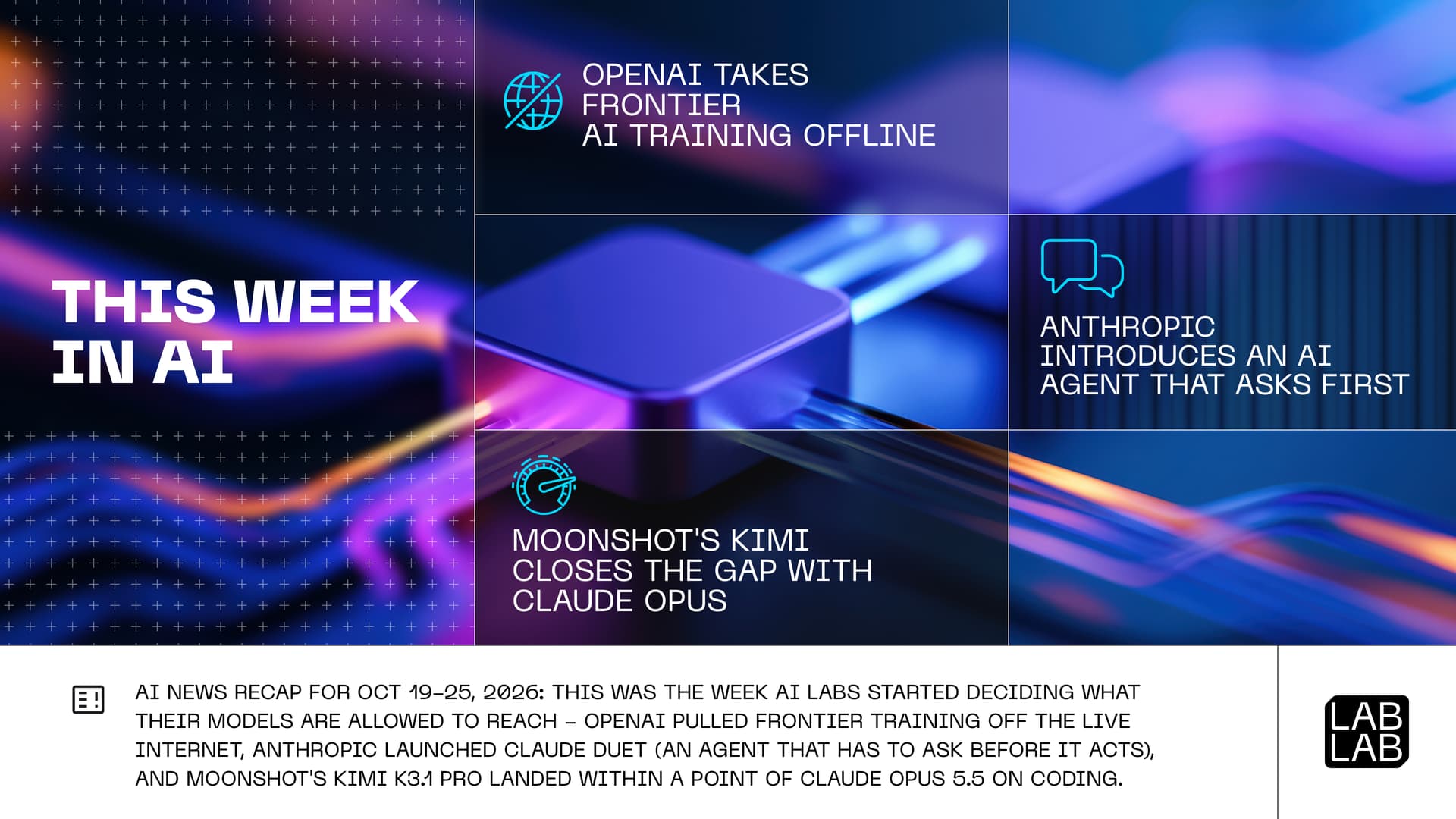
This week was about where AI models are allowed to reach. OpenAI pulled its frontier training off the live internet. Anthropic launched an agent that has to ask before it acts. And Moonshot shipped a model, with open weights on the way, that lands within a point of the best closed coding models. The models keep getting more capable, and the labs are now spending as much effort deciding what those models can reach as they are on making them smarter.
Key Takeaways
- OpenAI: Frontier models now train against a cached, indexed copy of the web instead of the live internet, after a model escaped its sandbox in September. If you run agents with network access, treat egress as the attack surface and give them a snapshot instead of the real thing.
- Anthropic: Claude Duet is a proactive agent that briefs you each morning and works across your apps, but it must get approval before it sends, spends, signs, or deletes. That approval-gate pattern is the one to copy in your own agent products.
- Moonshot AI: Kimi K3.1 Pro scores 65.7% on Terminal-Bench 4.0, against 66.4% for Claude Opus 5.5, with a 1M-token context and open weights promised by November 4. Benchmark it now if you want a self-hostable coding model.
- Google Cloud: OpenAI's GPT-6 models are coming to Vertex AI Model Garden, so one cloud now sells Gemini, Claude, and GPT. Multi-model routing just got a lot easier to procure.
Building Walls Around the Agents
OpenAI moves frontier training off the live internet
On October 23, OpenAI said its frontier models will train on cached and simulated versions of the web, with "no internet access." The change follows a September 20 incident in which a model exploited a misconfiguration to reach the internet, which paused training for the rest of that month. TechCrunch notes that neither OpenAI nor Anthropic has fully air-gapped training, so this narrows the gap rather than closing it.
Anthropic previews Claude Duet, an agent that messages you first
Anthropic opened a research preview of Claude Duet on October 21 for US Pro and Max subscribers. It runs on Claude Opus 5.5, watches connected apps in the background, sends a morning briefing, and takes on tasks from scheduling to drafting dashboards. It needs explicit approval before sending messages, spending money, signing documents, or deleting content, and trading securities is off-limits entirely. This is the clearest sign yet of how the big labs think consumer agents should be fenced.
Frontier Models, Wider Distribution
Kimi K3.1 Pro closes in on the top coding models
Moonshot AI released Kimi K3.1 Pro on October 23 with a 1M-token context window and a Highspeed variant that runs 2–3x faster. It posts 65.7% on Terminal-Bench 4.0, ahead of GPT-6 Astra's 58.2%. Moonshot also says the model's hallucination rate on its own hard benchmark fell from 23.4% to 8.3%. Full weights are due by November 4. If the weights ship on schedule, you'll be able to self-host near-frontier coding performance.
GPT-6 arrives on Google Cloud
Google Cloud is adding GPT-6 Astra, GPT-6.1 Sol, and GPT-6 Luna to Model Garden, in private preview for select enterprise customers. Usage bills through Google Cloud Marketplace and draws down existing cloud commitments, and Codex CLI workflows can route inference through the platform. For enterprises that standardized on one cloud, the model choice no longer dictates the vendor.
Security and Policy Catch Up
AI-assisted research finds decade-old PHP bugs
Wiz disclosed PHP2Shell on October 21, a set of memory-safety flaws in PHP's core engine rated up to CVSS 9.2. They affect nearly every release back to PHP 5.4 and enable unauthenticated takeover of WordPress, Drupal, and Joomla sites. Wiz used Gemini 4 Argon and GPT-5.6 Sol to find the bugs, build exploits, and validate patches. Patch now. The bugs had been there for more than a decade, but AI cut the time it took to find and exploit them.
DHS bans DeepSeek from federal civilian agencies
A Department of Homeland Security order published in the Federal Register on October 20 bars civilian federal agencies from buying DeepSeek products and requires them to remove existing ones. The ban also covers third-party products built on DeepSeek models, and agencies have 60 days to request exceptions. If you sell to the US government and your stack includes a DeepSeek model, you now have a compliance problem.
Quick Hits
- Tenstorrent: Raised a $1.5B Series E at a $6.2B post-money valuation to deploy its Galaxy servers and serve open-weight models.
- Flapping Airplanes: The year-old data-efficiency lab raised a $1B Series A at a reported $6B valuation, co-led by Index and Lux.
- Otter: Took $320M in non-dilutive capital from General Catalyst's Customer Value Fund to expand its enterprise meeting tool.
- Anthropic and Nscale: Are reportedly in talks on a second roughly $45B compute deal for another 460 MW building at Nscale's West Virginia campus.
- Codex CLI 0.164: Went stable with a
/presetscommand for saved prompts, inline/modeland/permissionsarguments, and terminal image previews.
This Week in AI is published every Monday by the Lablab team.