
🤝 Top Collaborators

🤓 Latest Submissions
BugDNA
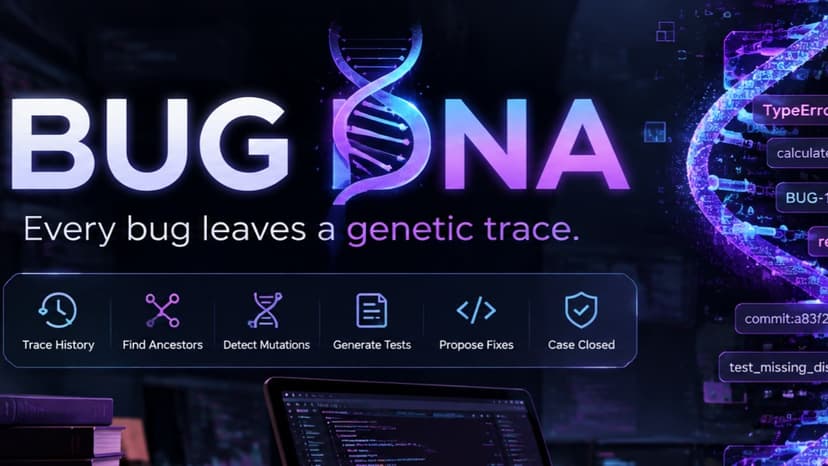
BUG DNA — Every bug leaves a genetic trace. Debugging often starts from scratch: developers investigate the current stack trace, search through source code, inspect old commits, look through previous issues, and manually determine whether a similar problem has already been solved. When historical fixes are incomplete or affect only one execution path, the same underlying bug can return in a different form, creating repeated debugging effort, regression risk, and unnecessary rework. BUG DNA is an agentic developer debugging and regression-analysis solution designed to answer a different question: “Have we seen this bug before?” Instead of treating every incident as isolated, BUG DNA reconstructs a bug's “DNA” from its error signature, stack trace, affected functions, code paths, historical incidents, previous fixes, documentation, and existing tests. It then investigates the evidence through specialized analysis agents representing a forensic workflow: a Historian searches previous incidents and fixes, Code Forensics traces affected code paths, a Test Detective identifies missing regression coverage, and a Document Analyst checks discrepancies between documented and implemented behavior. The system correlates these findings to identify a potential historical ancestor and detect “mutations” — cases where the same underlying weakness appears through a different execution path that the previous fix did not cover. For the prototype, BUG DNA demonstrates this workflow using a fictional payment-processing project and a realistic historical/current bug pair. Developers can move from incident analysis to historical matching, mutation detection, impact analysis, regression-test generation, fix proposal, and final verification through an interactive investigation experience. The target users are software developers, debugging teams, QA engineers, and engineering teams maintaining large or long-lived codebases. A developer can submit or select an incident, follow the investigation as multiple analysis agents work in parallel, inspect the evidence connecting the current bug to its historical ancestor, and review generated regression tests and a proposed fix before closing the case. What makes BUG DNA distinctive is that it combines historical debugging with an investigation-game experience. Rather than presenting another conventional AI coding assistant or dashboard, it turns debugging into a traceable forensic workflow where evidence, code paths, previous fixes, and tests form a connected “bug genealogy.” The result is a workflow designed to reduce duplicated investigation, uncover incomplete historical fixes, improve regression coverage, and help developers understand not only how to fix a bug, but why it keeps coming back.
27 Sep 2026
