
Abeeha Farrukh@Abeeha
4
Events attended
3
Submissions made
Pakistan
1 year of experience
About me
BS Statistics student passionate about Data Science, Data Analytics, and AI. Currently developing my skills in statistics, programming, and problem-solving while exploring how data and technology can create meaningful insights.
🤝 Top Collaborators




🤓 Latest Submissions

Buy You Before
# Buy You Before — FitLab: AI-Powered Spatial Commerce Buy You Before is an AI-powered furniture shopping platform that solves a common e-commerce problem: determining whether furniture will actually fit a customer's room before purchasing it. Customers can describe their requirements in natural language, browse suitable products, upload photographs of their rooms, and visualize selected furniture in an interactive 3D simulation. **Our core innovation is FitLab**, an AI-driven failure-diagnosis and repair system. Rather than simply rejecting an unsuitable product, FitLab analyzes simulation failures, proposes corrective actions such as rotating furniture or selecting an alternative, and executes new simulations to test those actions. An independent geometry engine verifies every result, ensuring that AI-generated suggestions are never mistaken for proven fit. For AMD ACT III, we aim to integrate an open AI model served through vLLM on AMD GPU infrastructure using ROCm. Evolus AI will orchestrate agent workflows and connect the model to our existing simulation services through MCP tools. We also plan to develop a reproducible benchmark comparing conventional geometry-based recommendations with AI-assisted repairs. Metrics will include verified repair success, false-fit claims, simulation attempts, and latency. These experiments will help us evaluate improvements and potentially fine-tune the model using recorded failure-and-repair examples. **Technology stack:** Next.js, React, TypeScript, Tailwind CSS, Three.js, Python, FastAPI, PostgreSQL, Dapr, Redis, OpenCV, Shapely, vLLM, AMD ROCm, Evolus AI, and MCP. Our mission is to transform furniture shopping from guesswork into evidence-backed spatial decision-making, demonstrating AI that does not merely recommend solutions but tests its decisions in an executable environment and proves whether they work.
18 Oct 2026
Bob, Verified
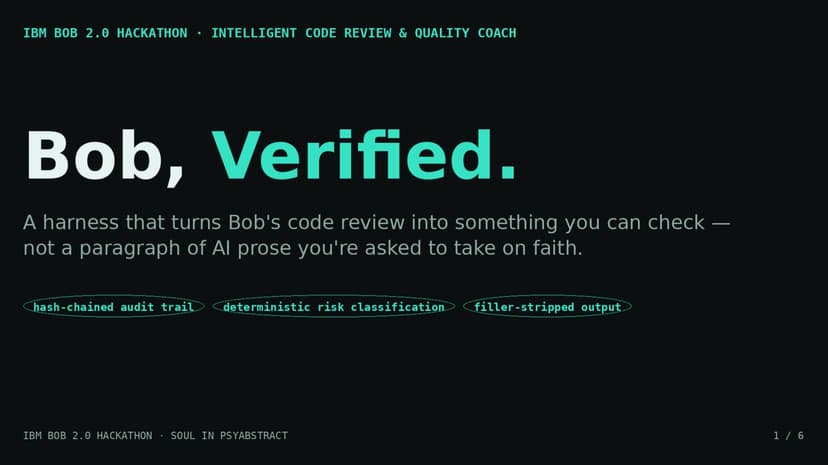
Bob does the code review. This project asks the next question: how do you know it actually did what it says? AI coding agents are usually graded on whether their summary sounds right, not on whether it matches what happened on disk. For a review tool, that gap is the whole product failing at its one job — you end up trusting the reviewer's word about the review, with no way to check it. This harness wraps Bob's Agent mode with two small, zero-dependency Python libraries built for exactly this: sipa-trace turns every tool call Bob makes into a hash-chained, risk-classified record. The classifier is deterministic and rule-based — it looks at tool capability (does this write, delete, touch the network, touch credentials), never at Bob's own judgment of its own action. An unrecognized tool falls through to the lowest risk tier by design, so it gets flagged for a human instead of silently waved through. verify() walks the whole chain afterward and confirms nothing was edited after the fact. sipa-signal runs Bob's own written explanation through a deterministic filter before a human reads it, stripping hedging and filler language. It's pattern-based, not another model summarizing Bob's summary — a second LLM in that role would just relocate the trust problem. The tool→risk mapping is generic on purpose: it classifies what kind of action a call is, not the domain of the task, so the same harness works on any repo Bob is pointed at. We ran it for real: Bob reviewed a sample file, made one tool call (read_file), correctly classified as no-risk, hash chain verified clean, and Bob's own review text passed the filter as CLEAN with 0% filler in that run. Task ID and exact numbers are in the repo. Impact: this turns "the AI said it worked" into something with a paper trail — a small, cheap step toward AI-assisted code review a team can actually rely on.
27 Sep 2026
Senu Startup Copilot
Startups often struggle with getting timely, specific, and accurate expert assessments, which leaves them unsure of their next steps and negatively impacts their productivity and motivation. Investors, on the other hand, face challenges in sifting through startups that lack critical information, which leads to high man-hour costs and uncertainty in tracking the progress of promising ventures. Introducing Senu: Startup Copilot, an AI-driven companion named after the eagle in Assassin’s Creed, designed to guide startups step-by-step through their building journey. Senu starts with an expert assessment, helps develop a clear roadmap, and recommends the best actions and resources to increase the likelihood of success. For investors, Senu offers clarity on which ventures are making rapid progress, ensuring no opportunity is overlooked. Senu saves startups time and money by providing instant expert feedback and eliminating the need for costly consultants and startup programs. It also enhances their chances of being matched with the right funding, services, or action steps. Senu is the future of startup building, providing comprehensive support for both entrepreneurs and investors.
7 Aug 2024


