

Akshat Sharma@AkshatSharmaXD
1
Events attended
1
Submissions made
India
2+ years of experience
About me
Akshat Sharma is a Full Stack Engineer and technology enthusiast with a strong interest in Artificial Intelligence, software development, and emerging technologies. He enjoys turning ideas into practical, scalable applications and has experience working across both frontend and backend development. His technical expertise includes React, Next.js, TypeScript, Python, FastAPI, Node.js, PostgreSQL, MongoDB, Redis, Prisma, Docker, and cloud platforms such as GCP. He also works with modern AI technologies including LLMs, RAG systems, computer vision, AI agents, and vector search. Akshat has worked on diverse projects ranging from AI-powered applications and e-commerce platforms to urban safety systems, chatbots, recommendation engines, and real-time applications. He is particularly interested in building products that combine intelligent AI capabilities with strong full-stack engineering. Outside of technology, he enjoys sketching, playing musical instruments, gaming, and exploring new technologies. He is a continuous learner who enjoys solving challenging problems, experimenting with new ideas, and building things that have real-world impact.
🤝 Top Collaborators
🤓 Latest Submissions
HaloSAT: AI-Powered CME & Space Weather Monitor
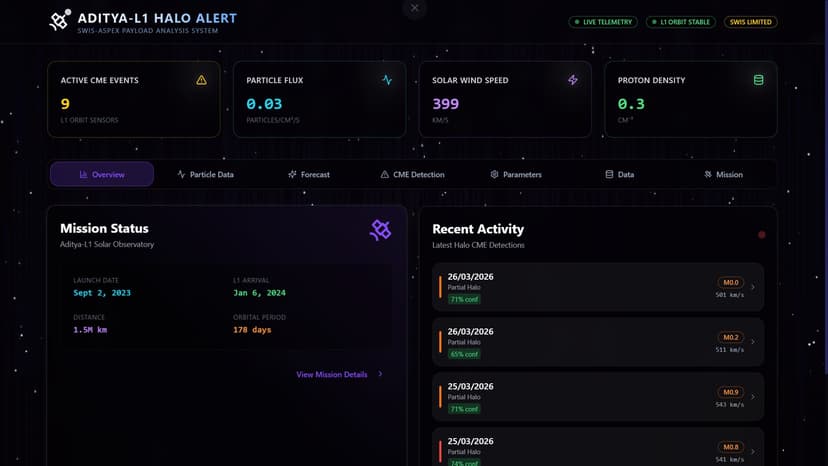
Problem: Coronal Mass Ejections (CMEs) are powerful solar eruptions that can trigger geomagnetic storms and disrupt satellites, communication systems, navigation, aviation, and electrical infrastructure. Timely detection and risk assessment are therefore critical for space-weather preparedness. Solution: HaloSAT is an end-to-end space weather monitoring platform designed to detect, analyze, predict, and visualize CME activity. The system combines real-time solar observations, multi-parameter CME detection, machine learning, satellite-related analysis, and interactive 3D visualization. Its workflow covers five major phases: real-time data acquisition, CME detection and classification, ML-based prediction, satellite/space-weather risk analysis, and interactive visualization. A dedicated field-data prediction component uses historical and incoming measurements to provide predictive insights. Target Users: Space agencies, satellite operators, aviation and communication organizations, power-grid operators, researchers, and academic institutions. Interaction: Users can monitor incoming solar data, review detected CME events, examine confidence scores and predictions, explore solar activity through interactive visualizations, and assess potential infrastructure risks. Creativity: HaloSAT brings real-time monitoring, AI/ML-based analysis, multi-parameter detection, 3D visualization, and satellite-level risk assessment together in a single platform developed by a two-student team. Efficiency: The LSTM model achieved 97.3% accuracy, while the monitoring pipeline refreshes data every 60 seconds and provides confidence-scored CME detection to support faster interpretation of solar events.
27 Sep 2026
