
🤝 Top Collaborators

🤓 Latest Submissions
OPTIONS ALPHA
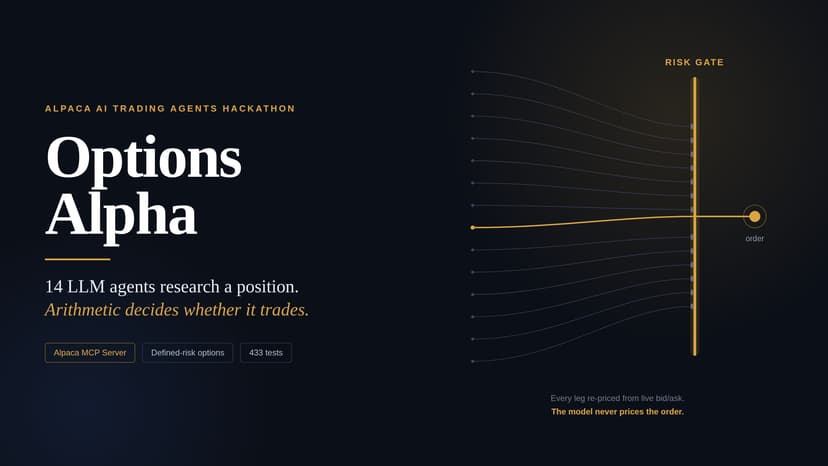
A broker API LLM is a liability. Can create a premium, or position size wrong, or open a spread whose legs fill separately, leaving a naked short. Most agents mistake authority for judgment. We keep them apart. 14 LLM Agents Research a Job It trades or not, according to deterministic code. 14 agents in 4 teams run a LangGraph state machine: five parallel analysts, a bull/bear debate with a manager who adjudicates, a trader and options strategist, then a three-stance risk debate whose judge can overrule the trader. “Agents choose the shape of a trade. They never price a trade. A deterministic gate re-prices every leg from live bid/ask, re-computes net premium and max loss, and vetoes invalid quotes, spread > 20% of mid, risk-sized loss > 2% of equity, debit above buying power, collateral shortfall, or any unbounded loss. It re-runs on new quotes before submission and drops the plan if the judge changes direction. So says a regression test: The model requires a $99.99 premium on a $2.00 spread-the gate sends $2.00. Then you manage positions. Legs group into structures (a 4-leg condor is one position) and close on a stop (1.5x credit, or 50% of debit), a target (35% of premium) or 21 DTE - as a single MLEG order, on a timer independent of the agent graph. Powered by Alpaca paper trading on the official Alpaca MCP server (uvx alpaca-mcp-server) with alpaca-py as fallback. Uses MLEG spreads, bracket/OTO equity stops held at the broker, and portfolio history for the equity curve. Now, a web app with seven workspaces includes a live dashboard, an Options Desk with each veto reason, and a ledger that links each order to the run that created it. 433 offline tests Couple filled trades, honest limit. We demonstrate governed independence, limited power, predictable hazard, complete auditability, not a verified advantage. Aashir Noman—AI Engineer Almas Sultan—Economist
4 Sep 2026

