
🤝 Top Collaborators
🤓 Latest Submissions
AI Cheat Detection for Coding Exams
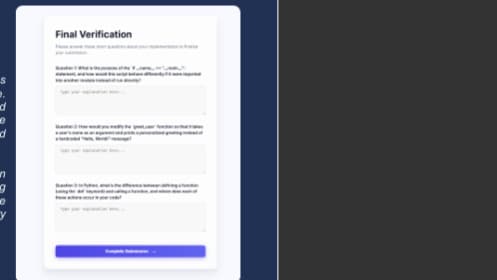
Online coding tests have become a core part of academic evaluation, but the rapid rise of generative AI tools like ChatGPT and GitHub Copilot has made it trivially easy for students to produce correct, working code in seconds without engaging in the actual problem-solving process. Traditional plagiarism detection systems, which rely on text similarity and direct code comparison, are fundamentally unequipped to catch this: AI-generated solutions are often syntactically unique, using different logic, variable names, and structure than any other submission, allowing them to slip past copy paste filters undetected. The challenge institutions now face isn't "is this code copied?" but rather "did this student actually write and understand what they submitted?" Code Integrity addresses this authorship crisis directly. Rather than relying on surface level text matching, our system introduces a behavioral analysis layer that verifies genuine understanding, not just code correctness. The platform works through three integrated mechanisms. First, Coding Style Fingerprinting uses Abstract Syntax Tree (AST) parsing to analyze each student's individual coding patterns indentation style, variable naming conventions, comment usage, and structural choices — building a unique behavioral profile per student over time. Deviations from a student's established fingerprint flag a submission for review. Second, Adaptive Follow Up Verification scans submitted code for complex constructs such as loops, recursion, and data structures, then automatically generates concept-specific questions (e.g., "why did you choose a while loop over a for loop here?" or "how would this function behave if imported as a module?"). A student who cannot answer basic questions about their own submitted logic raises a clear authenticity concern. Third, a Faculty Dashboard consolidates these signals into simple suspicion levels: low, medium, or high alongside side-by-side code comparisons and fingerprint similarity scores. Critically, the system applies no automatic penalties. It is explicitly designed as a decision support tool: faculty retain full authority over academic integrity outcomes, using the platform's output to guide further investigation or conversation with students, rather than to auto flag or fail them. Target users are educational institutions running online coding assessments primarily faculty and academic administrators responsible for exam integrity, with students interacting indirectly through the exam interface (a distraction-free code editor with monospace font and syntax highlighting) and directly through the adaptive follow-up questions triggered at submission time. What makes this creative and unique is the shift in detection philosophy: instead of comparing code to other code (which fails against AI generation), we compare a student's code to their own established behavioral baseline, and pair that with real-time comprehension checks effectively a "viva voce" moment built into the submission flow. This combination of AST-based structural fingerprinting and dynamically generated conceptual questioning has not been addressed together in existing academic tools, most of which focus solely on static similarity scoring. The result is a system that efficiently narrows faculty attention to genuinely suspicious cases (reducing false positives common in naive text-matching tools) while remaining privacy-first using only behavioral and submission-based signals, with no biometric data collection — and keeping human judgment central to every final decision.
27 Sep 2026
