
🤓 Latest Submissions
DEVGUARD2.0-Behavioral Safety for AI Coding Agents
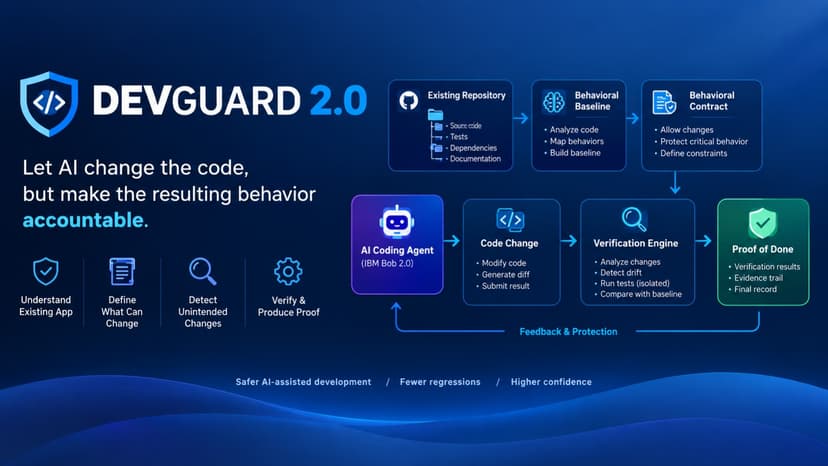
AI coding agents are becoming increasingly capable of modifying existing software, but successfully completing a requested task does not always mean that the application's existing behavior has been preserved. An AI agent may implement the requested change while unintentionally modifying another business rule, creating regressions or behavioral drift that can be difficult to detect and explain. DEVGUARD 2.0 is a behavioral safety and verification layer for AI-assisted software maintenance. It helps developers understand an existing application, reconstruct important behaviors, define what is allowed to change, protect critical behavior, detect unintended changes, and verify the final result. DEVGUARD first analyzes an existing repository, including its source code, tests, dependencies, and documented behavior, to establish a behavioral baseline. The developer then creates a maintenance request. DEVGUARD converts that request into an explicit behavioral contract, separating the behavior allowed to change from behaviors that must remain protected. The developer can then use an AI coding agent to perform the maintenance task. For our IBM Bob 2.0 prototype, IBM Bob is the demonstrated coding agent. DEVGUARD prepares the relevant context and behavioral constraints, while the coding agent remains responsible for making the actual software change. DEVGUARD then evaluates the resulting change instead of simply trusting the agent's completion message. To demonstrate the complete workflow, we built a controlled sample application called LegacyShop. LegacyShop represents an existing application containing interconnected business rules such as customer discounts, coupon ordering, tax calculation, checkout behavior, and refunds. In our demonstration, the developer requests: increase the Enterprise customer discount from 10% to 15%. DEVGUARD creates a contract allowing only the Enterprise discount to change while protecting Loyalty discounts, tax calculation, coupon ordering, and refund calculation. We then demonstrate a controlled failure where the AI-generated change correctly modifies the Enterprise discount but also unintentionally changes the Loyalty discount from 10% to 15%. DEVGUARD analyzes the actual change, detects intent drift, identifies the violated protected behavior, and blocks the result. After the unintended change is corrected, DEVGUARD performs deterministic verification in an isolated working copy, confirms that protected behaviors remain intact, and produces a Proof of Done containing the evidence trail. The target users are developers and engineering teams maintaining existing or legacy software with AI coding assistants. DEVGUARD is designed to fit around the developer's existing workflow rather than replace their coding agent. The demonstrated IBM Bob integration is one example. The underlying verification layer is agent-agnostic because its integration point is the resulting software change. The same architecture could support other coding agents such as Codex, Claude Code, Gemini CLI, or IDE-based agents. A developer could connect their repository to DEVGUARD, establish a behavioral baseline, define the maintenance request and protected contract, use their preferred coding agent to modify the code, and provide the resulting code change or Git diff to DEVGUARD. DEVGUARD could then perform drift detection, deterministic verification, and generate proof of the result. The current prototype exposes the DEVGUARD engine through a REST API. Git/Pull Request and CLI/IDE integrations are potential future adoption paths. Developers would not need to replace their preferred AI coding agent or modify its underlying model. DEVGUARD's core principle: let AI change the code, but make the resulting behavior accountable.
27 Sep 2026
