
🤝 Top Collaborators

🤓 Latest Submissions

DocAssist-AI
Clinic visits often begin with repeated questions, language barriers, and rushed intake. Doctors lose time collecting basic details, and patients with urgent symptoms can wait in the same queue as everyone else. DocAssist AI makes this first step safer, clearer, and faster for both patients and doctors. A patient picks a language, gives consent, and describes their symptoms to an AI that asks one short question at a time. The AI flags possible emergencies, suggests the right type of doctor, and books a queue token. The doctor then sees a structured summary with a confidence badge, so they know how far to trust it, and reviews every AI suggestion, approving or rejecting each one and giving a reason when rejecting. A medicine check compares the medicines the patient mentions with the doctor's list and marks anything only the AI suggested. After treatment, the patient sees the doctor's approved advice and can rate the visit. Safety is built into every step. The AI never gives a diagnosis or names medicines in its chat replies, and its suggestions appear only after the conversation ends and stay pending until a doctor decides. If a patient describes a possible emergency, the intake stops and the app tells them to get help now. Patients give consent before any data is entered, and our demo uses fake data only. Because a doctor approves or rejects everything, nothing reaches the patient without human review, and an accuracy panel tracks how often doctors agree with the AI. On our test cases, the emergency check recorded 0 missed emergencies and 0 false alarms. DocAssist AI is built with React, Vite, and Node.js. The AI runs on Gemma-4-31B-IT served through AMD Token Factory.
18 Oct 2026
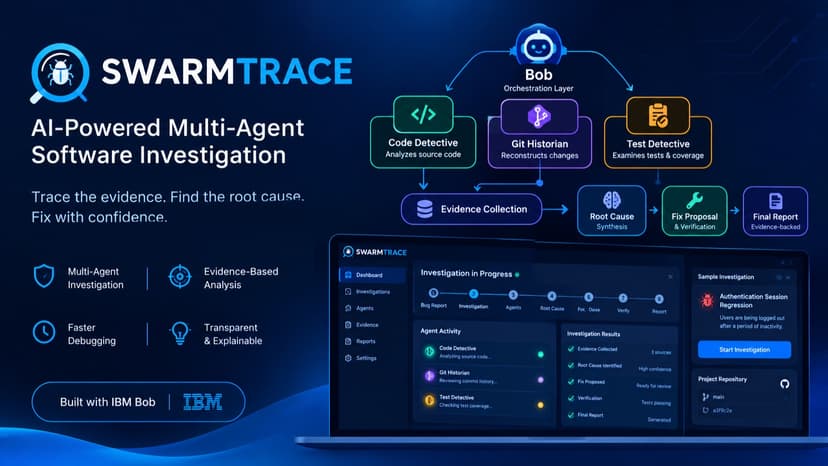
SWARMTRACE — Multi-Agent Bug Investigation
SWARMTRACE is an AI-powered software investigation system designed to help developers understand why a bug happened, not simply generate a possible fix. PROBLEM: Debugging difficult software failures often requires developers to investigate several disconnected sources of evidence. They may need to inspect source code, reconstruct Git history, identify the change that introduced a regression, examine existing tests, and determine what test coverage is missing. This process is time-consuming and it is difficult to maintain a clear chain of reasoning from the original bug to the final fix. Most AI coding tools focus primarily on generating or modifying code rather than providing a transparent, evidence-driven investigation. SOLUTION: SWARMTRACE treats debugging as a structured investigation. A bug report is passed to specialized investigators that examine different evidence sources. The Code Detective analyzes the implementation, the Git Historian reconstructs relevant historical changes, and the Test Detective examines existing tests and missing regression coverage. Their findings are collected as structured evidence and synthesized into a root-cause analysis. The system then produces a concrete fix proposal, recommended regression tests, verification results, and a final investigation report. This creates an explainable chain from bug report → evidence → root cause → fix → verification. TARGET USERS: SWARMTRACE is designed primarily for software developers, engineering teams, students learning software debugging, and maintainers working with unfamiliar or complex codebases. USER INTERACTION: A developer submits or selects a bug investigation target through the SWARMTRACE interface and starts an investigation. The system coordinates the specialized investigation workflow and presents the resulting evidence, root cause, proposed fix, verification, and final report through the dashboard. CREATIVITY AND UNIQUENESS: The key idea is to treat software debugging as an evidence investigation rather than simply asking an AI to generate code. Different investigators independently examine different sources of evidence, allowing conclusions to be corroborated across code, history, and tests. The result is a more transparent debugging process where developers can understand why the system reached its conclusion. The demonstration includes a realistic authentication/session regression specifically designed to require evidence from multiple sources, making the investigation workflow observable and verifiable rather than a simple code-generation demonstration.
27 Sep 2026


