
🤝 Top Collaborators



🤓 Latest Submissions
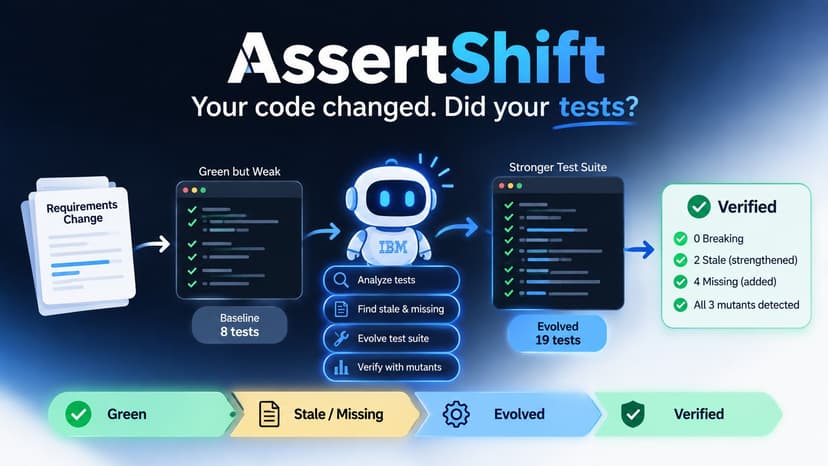
AssertShift
Your code changed. Did your tests? AssertShift is a developer workflow built around IBM Bob 2.0 that helps test suites evolve when software behavior changes. A passing test suite can create false confidence. Existing tests may still be green while asserting outdated behavior too weakly, or they may completely miss newly introduced requirements. AssertShift addresses this by giving Bob the approved behavior change, implementation, and existing tests, then asking it to reason about how the test suite should change. In the prototype, Bob identified 2 STALE tests whose assertions no longer adequately constrained the new behavior and 4 MISSING coverage areas introduced by the updated requirements. Bob then evolved the suite by tightening 2 existing tests and adding 11 new tests, growing the suite from 8 to 19 tests. AssertShift does not stop at generating tests. It verifies whether the evolved suite is actually stronger. A deterministic verification matrix runs the baseline and evolved suites against the correct implementation and three controlled single-defect mutants. All three mutants escape the original green baseline suite, while all three are detected by the evolved suite, with zero infrastructure errors. The result is a reproducible workflow that connects requirements → test intent → test evolution → executable evidence. Mutation testing is used as the proof mechanism, not the product itself. The core idea is requirements-driven test-suite co-evolution: detecting when tests no longer evolve with the behavior they are supposed to protect.
27 Sep 2026

Machine Yearning
This project implements an ultra-efficient, production-ready hybrid LLM orchestrator designed specifically to maximize accuracy while minimizing token consumption on resource-constrained grading infrastructure. At its core sits a deterministic this routing engine analyzes incoming prompts using hyper-calibrated keyword heuristics. Simple, general-knowledge queries are processed entirely offline via a localized Llama-3.2-3B model, delivering instant answers at zero token cost. Conversely, complex "trapdoor" tasks—such as Python code debugging, named entity recognition (NER), and advanced logic puzzles—are instantly identified and routed to the high-performance cloud API fallback, kimi-k2p7-code. The specialized, highly restrictive system prompts isolate the cloud model’s execution, suppressing chatty conversational preambles and forcing immediate, auto-grader-compliant outputs. Operating with multi-threaded configurations tailored to the evaluation server's 2 vCPUs and strict 4GB RAM threshold, this decoupled architecture provides an elite, predictable, and fully scalable solution that guarantees accuracy on the very first attempt.
13 Jul 2026


