

🤝 Top Collaborators




🤓 Latest Submissions
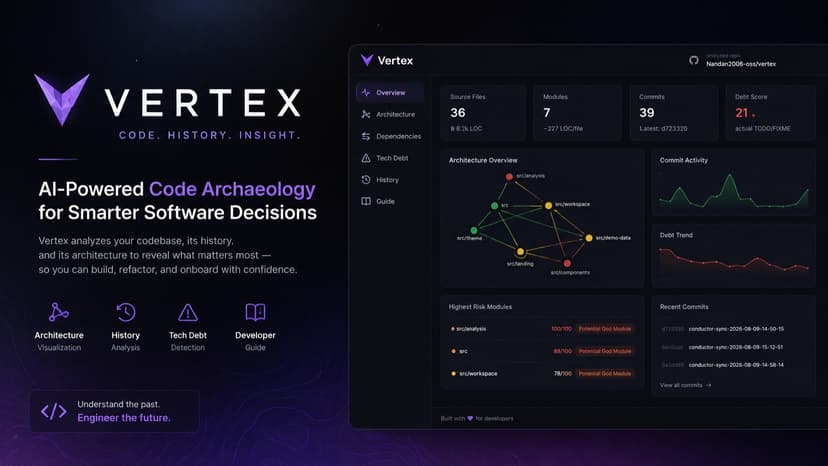
Vertex - Code Archaeologist
Vertex — Code Archaeologist is a developer tool designed to help developers understand unfamiliar and evolving codebases faster. As repositories grow, reading individual files is not enough to understand how the system is structured, which modules are tightly connected, where maintenance risks are concentrated, or how the architecture evolved. This information is often scattered across source code, dependencies, and Git history, forcing developers to manually piece everything together. Vertex brings these signals into a single interactive workspace by analyzing repository source code and Git history through six complementary views. Overview provides a high-level snapshot of repository structure, activity, health, and key findings. Architecture visualizes relationships between modules and highlights highly connected areas using dependency structure, fan-in, and fan-out. Dependencies provides detailed file and module relationships backed by evidence from actual source-code imports. Technical Debt identifies areas that may require greater maintenance attention. Its risk score is not a prediction of bugs; it is a maintenance/change-risk indicator based on signals such as complexity, code churn, coupling, size, and contributor concentration. History examines commits, contributors, churn, and files that frequently change together. These patterns can reveal architectural coupling that may not be obvious from the current code structure. Developer Guide helps developers entering an unfamiliar repository by identifying entry points, important modules, risky areas, and a recommended exploration path. Vertex is not intended to replace developers or simply summarize code. Its goal is to turn scattered technical information into actionable context, helping developers understand a system faster and make better-informed decisions. Ultimately, Vertex answers four questions: What is here? How is it connected? How did it evolve? Where should I look first?
10 Aug 2026
AI crisis coordinator
AI Crisis Coordinator is an intelligent, agentic AI system built using IBM watsonx Orchestrate that helps organizations manage emergencies with speed and accuracy. The agent continuously monitors multiple data sources such as alerts, reports, emails, sensors, and dashboards to automatically detect potential crises. Once a risk is identified, the agent evaluates severity, gathers relevant context, and triggers predefined workflows. It can notify teams, assign tasks, generate incident reports, escalate issues, and support decision-making in real time. The goal is to reduce human bottlenecks, improve coordination, and ensure faster crisis response by combining automation, integrations, and AI-driven analysis within a single orchestrated system.
23 Nov 2025


