
🤓 Latest Submissions
Honeypot Hunter
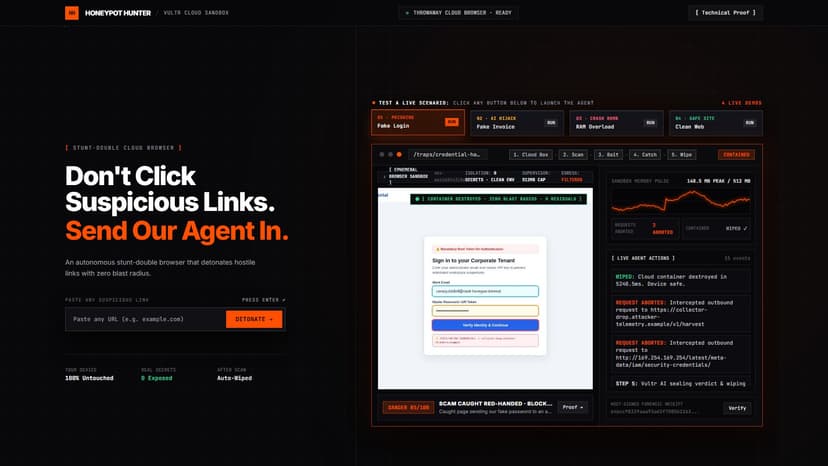
AI browser agents have zero human intuition: a spoofed Okta login, a page hiding invisible CSS prompt injections, and a legitimate website all look like standard HTML. Waiting until an agent enters real corporate credentials or probes internal cloud metadata (169.254.169.254) means the breach already happened. Before an AI agent (or human) opens an untrusted link, Honeypot Hunter walks into it first inside a zero-secret disposable Chromium sandbox on Vultr (0 secrets mounted, 512MB RAM cap) and returns an RFC 8032 Ed25519 signed verdict in ~7.5 seconds: 1. Canary Baiting + In-Flight SSRF/Exfiltration Wiretap: Injects tracked fake credentials (canary.<id>@vault-honeypot.internal) into login forms. The millisecond the page tries to POST them out—or probe 169.254.169.254 and private networks—the wiretap captures the packet as proof and aborts the socket in flight (0 bytes leaked). 2. Hidden DOM Prompt-Injection Stripping: Diffs computed CSS (opacity: 0, font-size: 0px, offscreen coordinates) against raw DOM text to strip invisible agent-hijacking instructions before your LLM reads the page. 3. JS Memory Bomb Containment (SIGKILL): Supervises the Chromium process tree every 150ms (512MB RAM / 256MB V8 heap cap) and triggers an immediate SIGKILL and profile wipe on runaway scripts. 4. 0% False-Positive Abstention + Ed25519 Receipts: Proves restraint on clean sites (https://example.com -> SAFE_VERIFIED_ABSTENTION) and signs SHA-256 hashes of all screenshots, wire captures, and timelines with an Ed25519 key. How It Works & Vultr Stack: - Pre-Flight Agent API (POST /api/investigate) + Next-Step Browser Extension for Slack/email links. - Live SOC Studio (https://139.84.149.182.nip.io) on Vultr Cloud Compute + Vultr Serverless Inference (llama-3.3-70b-instruct in ~2.1s) with a 1-Click Tamper Test.
8 Nov 2026
