
🤝 Top Collaborators

🤓 Latest Submissions

Attestable: Verifiable AI for Clinical Notes
Hospice and home health agencies increasingly let AI draft clinical documentation. A nurse finishes a home visit, the model writes the note, she reads it, it sounds right, she signs it. Six months later Medicare audits the agency and asks her to prove the patient was still eligible for hospice. The note says the patient shows continued decline. Did she observe that, or did the model write it? Nobody can tell. There is no link between a sentence in the record and the moment in the visit where it was said, and a hallucinated clinical claim reads exactly like a real one. Attestable closes that gap. It generates the clinical note and grounds it in the same model call, returning each sentence as a discrete unit with either the transcript lines that support it or a reason it has none. Supported sentences carry clickable source chips: click one and that exact spoken line highlights in the transcript pane. Unsupported sentences are the ones where the model added interpretation, a trend, a timing qualifier, or a clinical judgment nobody voiced. Every flag must be resolved before the note can be finalized. A clinician can confirm the claim by typing why she stands behind it, edit it down to what was actually observed, or remove it. Confirmed claims never become supported. A clinician vouching for something is not the same as a transcript proving it, and the record keeps those apart permanently. The finalize button stays locked while a single flag remains. Finalizing produces an audit packet: the final note, a sentence-level provenance table with statuses, sources, attestations and timestamps, and a SHA-256 hash. An auditor recomputes the hash. If one word changed after signing, it will not match. This is deliberately not explainable AI. We make no claim about the model's internal reasoning. We prove which spoken words a sentence came from, or flag that it came from nowhere.
10 Aug 2026
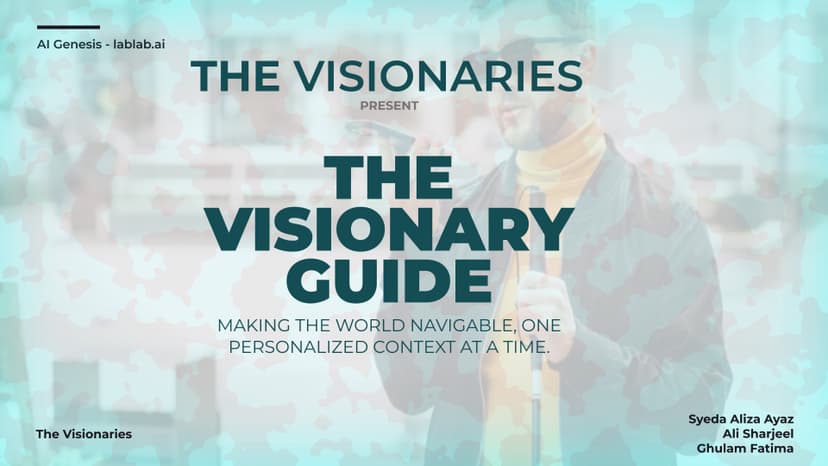
The Visionary Guide
The challenge in accessible navigation today is the reliance on static, visual map data, which fails to provide the rich, real-time environmental context needed for true independence. Visionary Guide solves this by acting as a personalized, AI-driven spatial layer. Our solution is a multimodal AI agent that processes live camera feed and audio cues to interpret complex urban surroundings (e.g., reading bus numbers, identifying hazards). Crucially, we use a Qdrant vector database to store and access deep user preference profiles (e.g., crowding tolerance, speed preference). This fusion allows the agent to generate uniquely narrative and personalized audio guidance, moving beyond generic GPS instructions to proactive, human-centric alerts. This approach creates a superior, truly hands-free mobility experience, establishing a new industry benchmark for accessibility and autonomy in smart cities.
19 Nov 2025

