
🤝 Top Collaborators


🤓 Latest Submissions
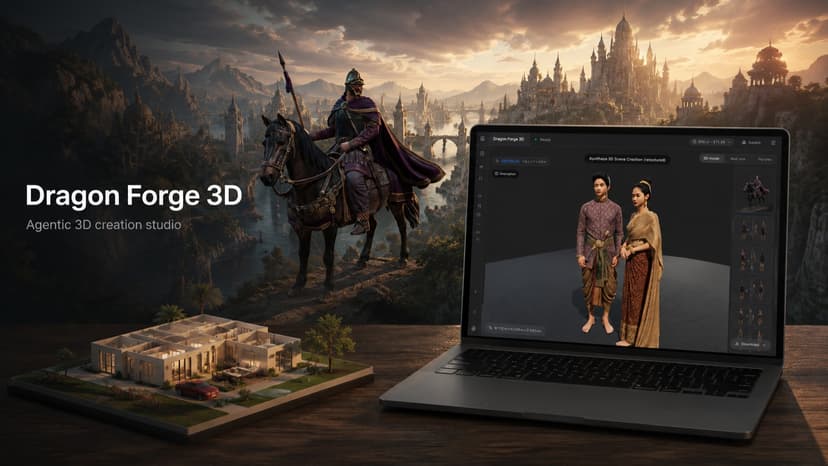
Dragon Forge 3D: Agentic 3D creation studio
3D content creation is widely used across games, architecture, simulation, entertainment, visualization, and other digital applications. However, producing 3D content remains complex and fragmented, requiring specialized knowledge and multiple software tools. The main limitation is often not imagination, but the gap between what users can imagine and what they can practically create. Agentic Dragon Forge 3D is an agentic 3D creation studio designed to address this gap by integrating the 3D creation workflow into an intelligent, conversational environment. Users interact with an AI Agent through natural language to describe what they want to create, while the system coordinates research, visual reference discovery, concept development, preview generation, 3D generation, inspection, and refinement. The system is organized around two core components: FORGE and STAGE. FORGE focuses on creating usable 3D assets. The Agent can research the subject, identify relevant references, generate visual previews, create 3D models, and support retexturing, rigging, animation, and real-world scaling. The workflow is not fixed; the Agent can move between stages, repeat steps, or adapt the process according to user requirements and feedback. STAGE extends the workflow from individual assets to complete environments and worlds. It supports natural environments and architectural spaces, allowing users to assemble and manipulate assets within a scene. Users can either instruct the Agent through natural language or directly control the interactive interface. This creates a continuous workflow from imagination to 3D assets and from assets to worlds, while keeping the resulting 3D content usable beyond the platform for games, architecture, visualization, AR, and 3D printing. The system is built on Natively Builder and integrates OpenAI for agent intelligence and image generation, Serper API for web and image research, and Meshy API for 3D generation, retexturing, rigging, and animation.
10 Aug 2026
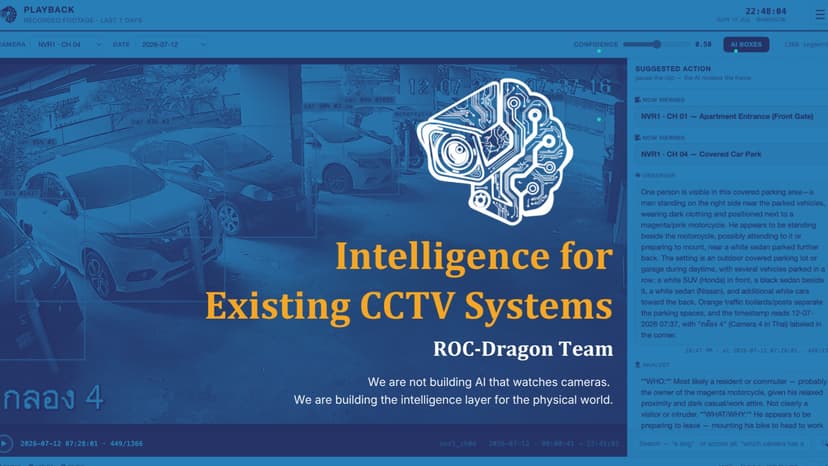
Intelligence for Existing CCTV Systems
Most organizations have CCTV and have invested in surveillance. Yet teams still spend hours—or even days—reviewing footage before making a decision. The cameras work; humans must connect events across time, locations, and multiple screens. Our AI Investigator unlocks the intelligence hidden inside that investment. Operators can ask: What happened? Is this normal? Who was involved? Does it require action? The system investigates the footage and returns a verified answer with video evidence. The result is a new way to operate CCTV. Investigations that once required hours or days of manual review can now be completed in minutes—and sometimes seconds. This is not merely faster video search. It is a paradigm shift from passive recording to an intelligent system that understands the physical world and delivers verified answers. The platform builds a camera graph enriched by VLM scene understanding, allowing it to learn how spaces connect and what each location represents. RT-DETR detects people and objects, BoT-SORT tracks movement, and OSNet links the same person across 28 cameras under one identity. Gemma converts scenes into searchable activity logs and recognizes fights, package handling, unusual crowding, and routine logistics. When an investigation is needed, the system reconstructs a person’s journey across cameras, summarizes the movement, and provides relevant clips. A second vision model verifies each result before delivery, reducing false positives and unnecessary alarms. The complete pipeline runs on a single AMD Instinct MI300X using ROCm, MIGraphX, and vLLM-ROCm. Its 192 GB of HBM3 allows detection, tracking, re-identification, vision understanding, and agentic reasoning to operate together across 28 streams. No new cameras. No infrastructure replacement. Just faster investigations, better decisions, and more value from existing systems. We are not building AI that watches cameras. We are building the intelligence layer for the physical world.
13 Jul 2026

