
🤓 Latest Submissions
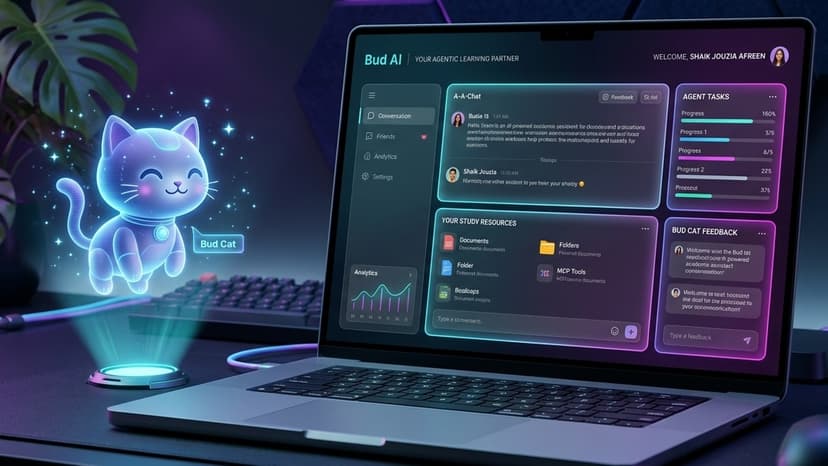
Bud AI - Agentic Learning Partner
Bud AI (Buddy AI) is an open-source, multi-agent educational assistant designed to solve mental fatigue and context-switching overhead for students. Key Problem Solved: Studying for intensive exams requires juggling huge syllabi, unstructured study guides, and static chat interfaces. Bud AI transforms study sessions by introducing structured, agentic AI orchestration and an emotionally engaging user workspace. Core Architecture & Features: Multi-Agent Orchestration & MCP: Uses FastAPI and custom tool discovery logic inspired by Model Context Protocol (MCP) to switch seamlessly between specialized "Teacher Personas" and academic retrieval tools. Dynamic Mood & Aura System: A responsive glassmorphic UI tracking focus, mood states, and interactive mascot feedback (Bud Cat) during late-night coding and study sessions. Structured Schema Validation: Powered by Next.js, Python, Pydantic, and Instructor for strict LLM output control and zero-lockin model integration. Why Open Innovation Matters: Bud AI allows students and developers to inspect study privacy, integrate custom university syllabi, and swap local open-weight models with cloud APIs without vendor lock-in.
6 Oct 2026
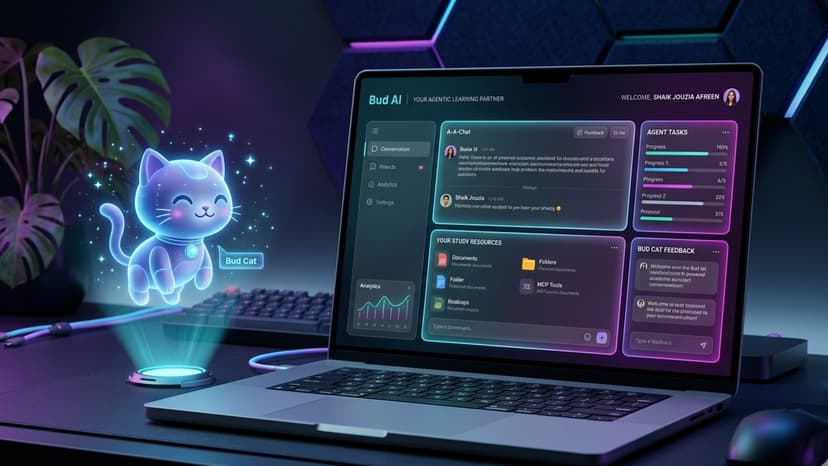
Bud AI:Agentic Personal Assistant &Study Companion
The Problem: Traditional AI learning tools treat education like a linear search engine. Students are forced to manually copy, paste, and feed massive amounts of local study files into standard chat inputs, rapidly drowning out context windows, increasing processing lag, and causing information fragmentation. My Solution (Bud AI): I built Bud AI to redefine the student workspace by transforming a standard chat application into a proactive, autonomous assistant layer. Developed entirely as a solo project, the platform features a React and Next.js front-end styled with a sleek, minimalist glassmorphism UI, communicating seamlessly with a robust Python backend designed to act as an active developer and learning partner. Instead of passing heavy static files into the LLM context, I implemented a high-performance Model Context Protocol (MCP) server. Running over JSON-RPC and secure stdio transport layers, the system enables the underlying model to dynamically execute local resource tools, query directory paths, and discover external data assets strictly on-demand. Core Innovation & Features:Teacher Persona System: Deployed target-driven context-aware retrieval to deliver highly accurate, structured academic responses tailored precisely to student interaction styles.MCP-Driven Tool Discovery: Empowered the agent to autonomously fetch real-time local file data and execute utility functions only when needed, keeping the context-window incredibly light.Multi-Agent Orchestration: Configured the backend architecture to split complex technical queries into specialized tasks, enabling collaborative sub-agents to solve problems step-by-step rather than relying on standard single-prompt outputs. Technology Stack Used Languages: Python, JavaScript, HTML5, CSS3, SQL AI Architecture:MCP,JSON-RPC protocol layers,Stdio Transport,Generative AI APIs,Context-Aware Retrieval pipelines.Front-end Frameworks: React, Next.js, Tailwind CSS.Development Environments : Git, GitHub, VS Code
17 May 2026


