
🤝 Top Collaborators
🤓 Latest Submissions
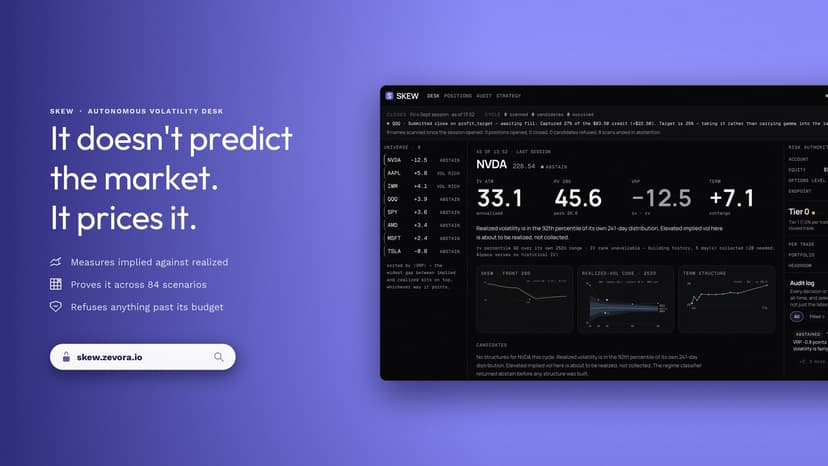
Skew: Autonomous Volatility Desk
Skew has no opinion on where any stock is going. No sentiment model, no bull case, no bear case, no forecast of any kind. Direction is not an input. It trades volatility instead. An option's price is dominated by how much movement the market expects before expiry, and that expectation runs persistently above the movement that actually occurs, because people pay for protection. That gap is the variance risk premium, a documented structural feature rather than a pattern found in a backtest. Capturing it requires no forecast. Every five minutes against live Alpaca chains, Skew computes implied volatility, realized volatility across three estimators, term structure slope, and the premium between them for eight liquid names. Rich volatility means sell defined-risk premium. Cheap means buy it. Neither, or a stressed curve, means abstain and log why. Structures are sized backwards from the risk budget, so the desk never builds a trade it is not permitted to take. Five gates then run, including a stress engine that reprices each exact structure across 84 scenarios: price shocks to three standard deviations, implied volatility doubling, at three points in time. One breached cell and it refuses, naming the scenario. Two things we have not seen elsewhere. The desk reconciles its book against the broker every cycle, and when its records diverged from reality it detected that itself and wrote thirteen dated corrections into a public log rather than quietly fixing them. And position size is earned: it starts at 0.5 percent of equity per trade and unlocks larger limits only by closing trades without a breach. Spreads execute as single atomic multi-leg orders. The desk is exposed over MCP, seven read tools always on and two write tools unregistered unless explicitly enabled. Across the competition it made over 2,600 decisions and acted on five. Every one is reconstructible to its inputs at skew.zevora.io/audit, including the refusals.
4 Sep 2026
