

🤓 Latest Submissions
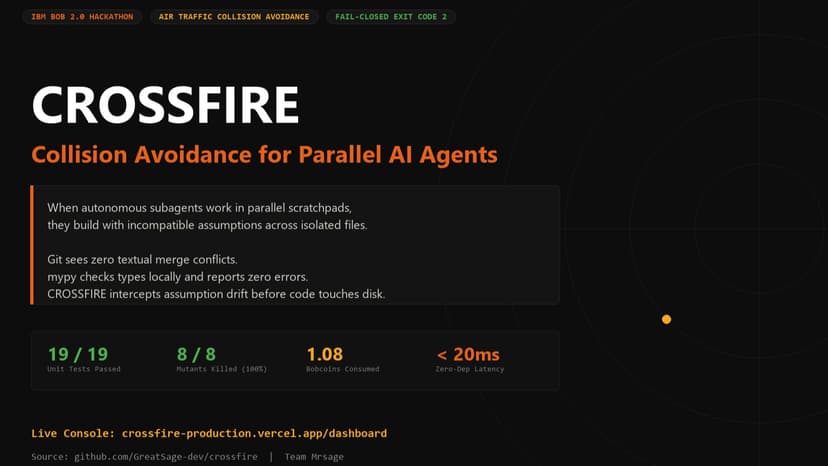
CROSSFIRE — Semantic Collision Radar for IBM Bob
### Problem Statement In 2026, software development is multi-agent. With IBM Bob 2.0, teams no longer wait for a single AI model to complete tasks sequentially. Bob spawns parallel subagents working across separate scratchpads and files simultaneously. However, this architecture introduces a dangerous, invisible failure mode: inter-agent semantic collisions. Developer tools were never designed for multi-agent workflows. Git was built in 2005 to compare lines of text within the same file—it reports zero merge conflicts when agents modify different files. Linters and type checkers (like mypy) inspect code in local isolation—when Subagent A specifies `timeout: int = 30` (asserting 1 to 60 seconds) and Subagent B passes `timeout: int = 5000` (assuming milliseconds), mypy evaluates `int == int` and reports zero type errors. The code deploys, and production crashes. Standard tools are blind to cross-agent domain assumptions. ### Solution: CROSSFIRE CROSSFIRE is an Air Traffic Collision Avoidance System (TCAS) for parallel AI agents. Rather than analyzing syntax after writes occur, CROSSFIRE intercepts incompatible assumptions across isolated agent scratchpads before code touches disk. Operating via a 4-step TCAS pipeline: 1. Intercept: Bob’s native PreToolUse lifecycle hook invokes CROSSFIRE prior to any file dispatch. 2. Mine: Pure Python AST visitors extract invariant claims across active scratchpads—mapping numerical value domains, temporal lifecycles (async vs. sync), and error contracts. 3. Collide: Conflicting assumptions trigger a fail-closed execution halt via Bob’s Exit Code 2. Ambiguous claims enter UNKNOWN_SUSPEND—CROSSFIRE enforces epistemic refusal and never hallucinates a guess. 4. Auto-Steer: CROSSFIRE generates an imperative Resolution Advisory with an exact patch hint (e.g., `timeout = timeout // 1000`). Bob ingests the advisory, self-heals Subagent B’s scratchpad, and the collision clears automatically. ### Target Users & Interaction - Target Users: Autonomous AI engineering teams, agent platform architects, and developers running parallel subagents in IBM Bob 2.0. - Interaction: Seamless and zero-friction. Developers configure CROSSFIRE as Bob’s PreToolUse hook. In the terminal, developers run `crossfire verify` to view deterministic differential matrix receipts. In the browser, engineers monitor the dark-mode TCAS Airspace Radar, live Assumption Ledger, and test custom code in the interactive Conflict Sandbox. ### Creativity & Uniqueness 1. Air Traffic Control for AI: Transposes aviation TCAS principles (Near Mid-Air Collision envelopes and Resolution Advisories) into multi-agent software engineering. 2. Tri-State Epistemic Law: Replaces unsafe binary pass/fail with COLLISION_HALT, UNKNOWN_SUSPEND, and CLEAR. 3. Contract Binding Over Text: Compares behavioral contracts rather than textual diffs or raw syntax. ### Impact & Efficiency CROSSFIRE runs in under 20 milliseconds with zero external runtime dependencies. In our in-memory Mutation Testing Lab, CROSSFIRE killed 8 out of 8 injected architectural mutants in 13.4ms, proving the safety harness is rigorous and non-tautological.
27 Sep 2026
KINLOCK: Bimanual VLA Flight Envelope Protection
Vision-Language-Action (VLA) models propose actions at 10–30 Hz, while physical robot servos execute at 1,000 Hz. In bimanual tasks—such as two robot arms carrying an object together—this frequency gap causes kinematic drift between the end-effectors. Documented in Hugging Face LeRobot Issue #3154, this drift generates over 2,000 N of internal tensile and compressive force, stripping servo gears and destroying physical hardware. KINLOCK provides deterministic, sub-millisecond Flight Envelope Protection (FEP) for dual-arm robotic systems. Positioned directly between any high-level VLA model and low-level servo controllers, KINLOCK projects unconstrained velocity proposals onto the null-space of closed-chain kinematic constraints using Moore-Penrose pseudo-inversion and Baumgarte drift stabilization (α = 12.0 s⁻¹). Benchmarked against dual SO-101 6-DOF arms on a 150-frame table-setting dataset, KINLOCK reduces peak internal strain from 2,033.99 N down to 0.02 N (100% attenuation) within a 72.5 μs callback dispatch, strictly preserving the 348.24 mm grasp invariant without interrupting ongoing task execution. Additionally, KINLOCK integrates Speechmatics Realtime WebSocket API for acoustic emergency reflexes. When an operator utters "STOP" or "HALT", KINLOCK parses the phoneme stream and triggers an exponential admittance deceleration curve: bringing arm velocities to a complete halt in under 50 ms while sustaining 100% gripper clamp torque so carried objects never drop.
16 Sep 2026

