
🤝 Top Collaborators

🤓 Latest Submissions
MediClear — AI Agents That Fight Denials
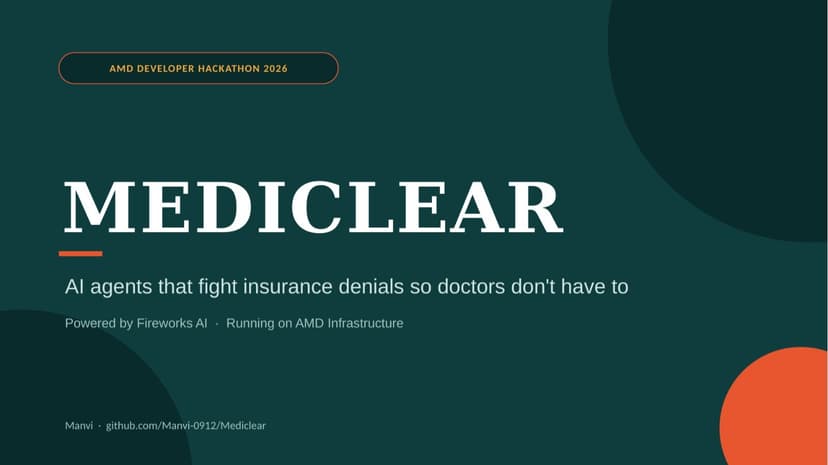
Doctors spend nearly 28 hours a week fighting insurance companies over paperwork instead of treating patients, and Stanford's own research earlier this year found that even the best AI system today completes only about 36% of these administrative tasks. Insurance claim denials are a massive, largely unsolved problem in healthcare — one estimated to cost the industry over a trillion dollars a year in administrative waste — and the people hurt most are patients who don't have the time, medical knowledge, or legal language to appeal a denial on their own. MediClear is a four-agent AI system built to close that gap. It takes a raw denial letter and transforms it into a complete, submission-ready appeal in seconds. The system runs four coordinated agents: an Orchestrator that reads and classifies the denial, an Appeal Agent that drafts a clinically-grounded appeal letter citing relevant medical guidelines and ICD-10 diagnosis codes, an Auth Agent that generates prior-authorization paperwork, and a Track Agent that monitors the claim's status and follow-up deadlines going forward. Inference runs through Fireworks AI's gpt-oss-20b model, hosted on AMD EPYC and GPU infrastructure — verified directly via rocminfo output confirming real AMD hardware access, not just a wrapper claiming it. The backend is built with FastAPI and deployed on Render; the frontend is built in React and deployed on Vercel. The entire stack is fully public, open source, and live — anyone can test it right now without any local setup. We built MediClear as second-year CSE students, under a tight hackathon deadline, because I wanted to build something that gives ordinary patients an advocate when they don't have anyone else fighting for them.
13 Jul 2026
PR Shield
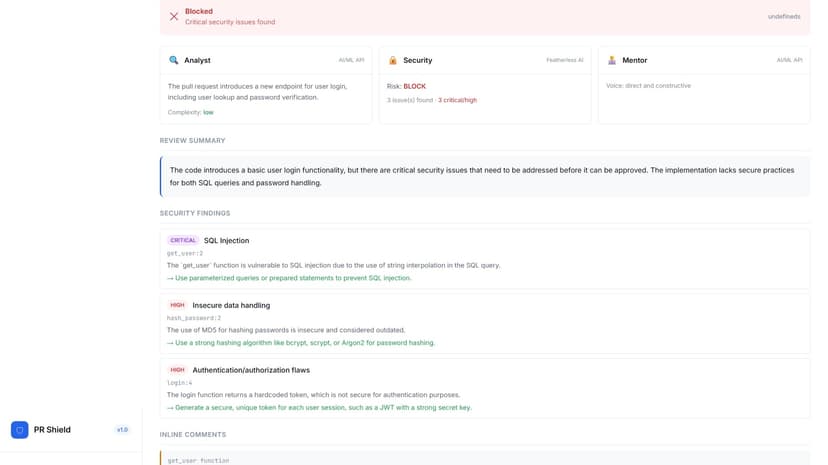
The Problem You submit a PR and get back AI feedback that could apply to any codebase anywhere. It doesn't know your team's conventions, what your senior developer cares about, or the context behind your changes. Generic AI reviews are noise, not signal. Senior developers waste 3–5 hours every week on reviews that AI should be handling better. The Solution — PR Shield PR Shield is a multi-agent AI code review system that learns your team and reviews PRs the way YOUR senior developer would. Three specialized agents coordinate through Band SDK: 🔍 Analyst Agent (AI/ML API) — Maps PR intent, identifies complexity and flags risk areas. 🔒 Security Agent (Featherless AI) — Scans for SQL injection, XSS, hardcoded secrets, and auth flaws using context passed from the Analyst. 🎓 Mentor Agent (AI/ML API) — Synthesizes both agents' findings and writes the final review in your team's voice. Style Memory — The Twist Feed PR Shield your team's merged PRs. It builds a reviewer persona — learning your naming conventions and what your senior developer pushes back on. Every review says "Reviewed as Alex Chen" — YOUR team's feedback, not generic AI. Gets smarter every sprint. Why Band SDK Makes This Possible Real agent handoffs — Security receives the Analyst's structured intent mapping. Mentor synthesizes both agents' findings. Each agent's output shapes the next agent's behavior. Not three API calls — actual multi-agent coordination. Business Value Every engineering team on earth needs this. GitHub Copilot reviews code generically — PR Shield reviews it the way YOUR team thinks. $50/team/month SaaS wedge into enterprise DevOps tooling. 🌐 https://pr-shield.onrender.com 💻 https://github.com/Manvi-0912/pr-shield
19 Jun 2026


