

🔥 Own Projects

🤓 Latest Submissions

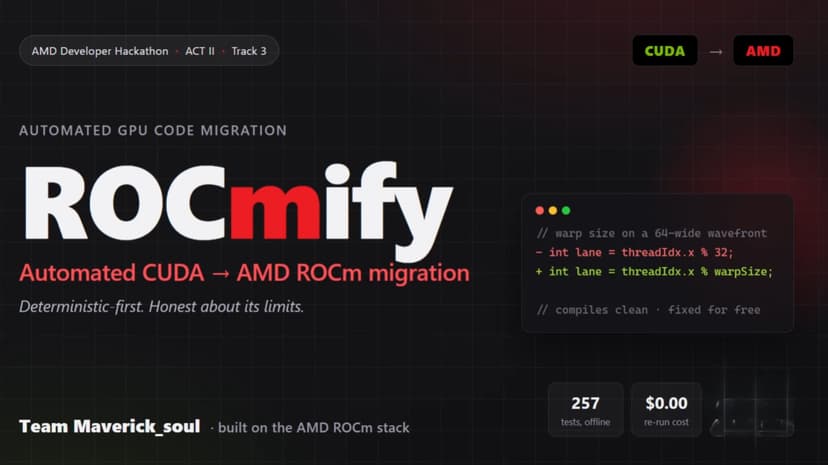
ROCmify - Automated CUDA to AMD ROCm Migration
Most AI and HPC software is written in CUDA, which only runs on NVIDIA GPUs. Porting it to AMD is usually a manual process that takes weeks, introduces subtle bugs, and keeps teams locked into NVIDIA even when AMD hardware is a better fit. The biggest barrier is not the hardware. It's the codebase you already have. ROCmify automates that migration with a cost-efficient, reliability-first pipeline. It starts by running AMD's HIPIFY tool and compiling with `hipcc`. If compilation fails, ROCmify classifies the compiler error and applies a deterministic repair plugin. If no rule matches, it checks a SQLite cache of solved patches. Both steps are free. Only then does it escalate to a language model on Fireworks. If the model fails three times, ROCmify restores the original file with `git checkout` and flags it for human review. Your code is never left half-modified. ROCmify also fixes problems compilers cannot detect. For example, code that hardcodes `threadIdx.x % 32` compiles on AMD but produces incorrect results because CDNA GPUs use 64-thread wavefronts instead of 32-thread warps. Using a tree-sitter AST, ROCmify rewrites these cases to the `warpSize` builtin, but only when the intent is unambiguous. If `32` could represent a tile size, it refuses to guess. Just as importantly, ROCmify knows when not to automate. Inline PTX, NVIDIA's low-level assembly, has no mechanical HIP equivalent. Instead of sending it to an LLM that might generate an incorrect translation, ROCmify quarantines it for manual review. An honest refusal is safer than a confident wrong answer. On real AMD hardware (ROCm 7.2, `gfx1100`), ROCmify performed one deterministic repair at $0.00, quarantined one PTX block, and required one LLM call costing $0.000084. A second run cost $0.00 because the fix came from cache. ROCmify includes 257 automated tests, is fully containerized, and runs on laptops without a GPU because `hipcc` supports cross-compilation.
13 Jul 2026

Quorum: Governed Business Intelligence
Quorum is a Band-powered governed analytics platform that turns natural-language business questions into trustworthy, auditable answers. Instead of relying on a single AI model, Quorum uses a council of specialized agents that collaborate through a structured governance workflow. A Planner creates an investigation strategy, a Plan Guardian reviews the approach before execution, a SQL Analyst generates and executes queries, a Cost Sentinel validates cost and plan compliance, a Governance Guardian reviews correctness after execution, and a Decision Reporter converts findings into actionable recommendations. Quorum supports two investigation modes. Governed Chain answers descriptive questions such as "What happened?" through a sequential review process. Investigation Board tackles diagnostic questions such as "Why did revenue decline?" by launching multiple investigators in parallel and using an adjudicator to evaluate competing explanations before reaching a conclusion. Built on Band's multi-agent framework, Quorum enables structured collaboration between agents, allowing them to plan, review, challenge, validate, and justify outputs before a result reaches the user. This creates a transparent decision-making process rather than a black-box AI response. A core innovation is Quorum's governance-first design. Every plan, SQL query, agent decision, cost estimate, compliance review, revision request, and final recommendation is captured in a complete audit trail. Users can inspect investigation timelines, generated SQL, governance decisions, and supporting evidence behind every answer. The platform combines FastAPI, Next.js, PostgreSQL/SQLite, and LiteLLM-based model routing with support for Groq, AI/ML API, Featherless, OpenAI-compatible providers, and Ollama. By combining Band's collaborative agent orchestration with enterprise governance controls, Quorum delivers explainable AI-powered analytics that organizations can confidently use for business decision-making.
19 Jun 2026


