

Muhammad Anis@Muhammad_Anis_475
3
Events attended
3
Submissions made
Pakistan
1 year of experience
About me
I’m Muhammad Anis, a software developer and AI engineer with more than 2 years of professional experience building modern web applications, scalable backend systems, and data-driven AI solutions. On the web and backend side, I have solid experience across the full stack—building intuitive interfaces with HTML, CSS, Bootstrap, Tailwind CSS, JavaScript, TypeScript, Alpine.js, and React.js, and engineering dependable backend architectures using Python, PHP, Laravel, and Node.js. I design relational and in-memory data layers with MySQL, PostgreSQL, Redis, and SQL, focusing on RESTful APIs, secure authentication systems, and smooth third-party integrations. For deployment and DevOps workflows, I rely on Git, GitHub, Docker, Vercel, and Hostinger, alongside hands-on experience in WordPress, SEO, and web performance optimization. In AI and Machine Learning, I work with Python to build practical, intelligent systems using foundational and modern techniques. My experience covers key machine learning workflows—from data preprocessing and feature engineering to training predictive models using logistic regression, decision trees, and foundational neural networks. I work comfortably with mathematical concepts that drive machine learning, including probability distributions, loss optimization, and statistical reasoning. Alongside training models, I integrate modern AI APIs, vector search, and LLM-driven tooling into production applications, using environments like Claude, OpenAI Codex, and Antigravity within VS Code. Overall, I focus on bridging robust software engineering with applied machine learning to deliver fast, reliable, and scalable real-world products.
🤝 Top Collaborators



🤓 Latest Submissions
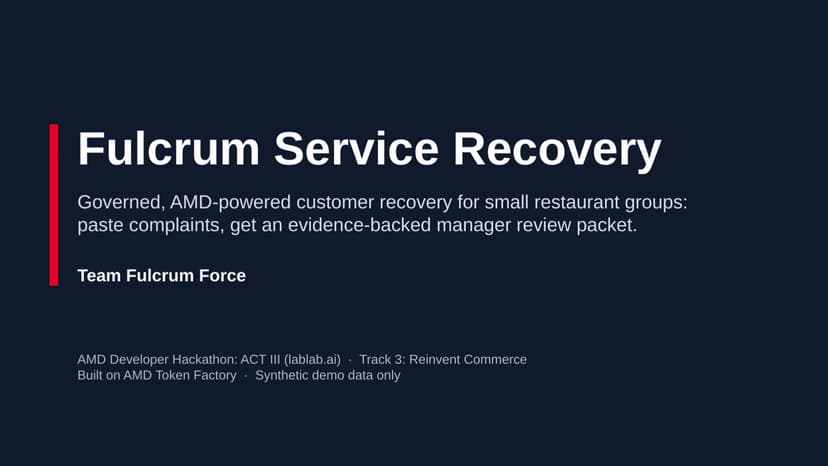
Fulcrum Service Recovery
Big delivery platforms run automated customer-recovery engines in-house. A 3–30 location restaurant group handles complaints by hand, from memory, under time pressure: slow, inconsistent, and refunds drift from policy. Fulcrum Service Recovery gives small groups that capability without handing decisions to a bot. Staff paste one or many complaints, optionally attach an anonymized order CSV, and pick a versioned written policy. AMD Developer Cloud Token Factory runs DeepSeek-V4-Flash (OpenAI-compatible API, temperature 0.2, JSON-only) to extract the issue, order refs and missing facts, and to draft a reply. Deterministic code then decides what is allowed: order verification, policy caps, never-automate rules, complaint-vs-record conflicts, and prompt-injection detection. Each case becomes a manager review packet: the draft (or why none was released), evidence refs for every claim, missing facts, inference provenance (backend, model, request ref) and an audit trail. Model error, timeout or bad JSON fails closed to manager review, with no silent fallback. Managers approve, reject or request info; decisions only record an audit event. Results on the live AMD backend (20-case synthetic eval): 20/20 correct routing, 100% packet completeness, 0 unauthorized side effects; median latency 6.24 s, p95 11.50 s on the shared endpoint. Built for shared capacity: 429 backoff honoring Retry-After, request timeouts, and a dedicated MI300X provider slot ready to configure. Next: MI300X deployment, a larger eval set, an owner policy editor, and a pilot with a restaurant group on its own written policy. All data is synthetic; no refunds, messages or customer contact. Stack: FastAPI, Pydantic, SQLite, Docker.
18 Oct 2026
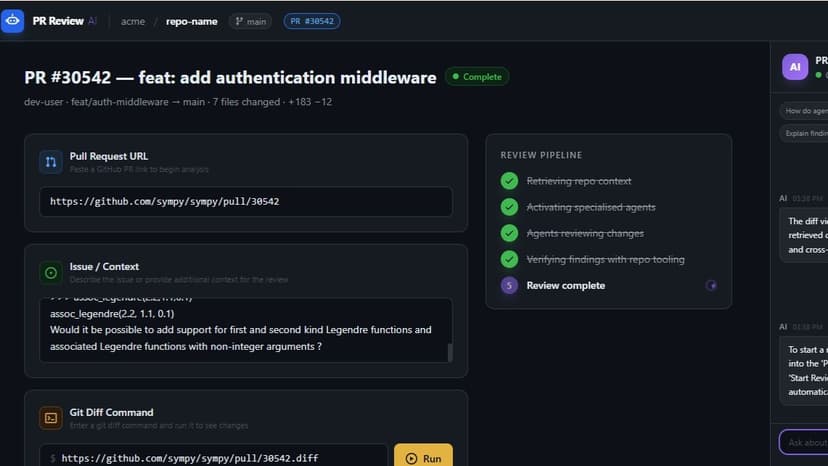
Code Lens
Reviewing pull requests in large software repositories can be difficult because a change may affect code, tests, dependencies, documentation, and other parts of the repository. Traditional automated reviewers often analyze only the changed lines and can miss important context or produce generic suggestions. Our solution is an agentic AI powered pull request quality checker that analyzes a pull request together with the relevant repository context. It first understands the type and scope of the change, then identifies related files, dependencies, tests, and documentation that may be affected. Specialized analysis steps can then focus on code quality, potential bugs, security concerns, test coverage, and regression risks. Instead of relying only on an AI generated opinion, the system can use relevant tests and other available evidence to support its findings. This allows the final review to distinguish between issues identified through reasoning and issues supported by actual verification. The system is designed for real world repositories, including large and private codebases where sending the entire repository to an AI model would be inefficient or inappropriate. It retrieves relevant context based on the actual pull request and applies analysis according to the type of change. The target users are software developers, open source maintainers, and development teams who want faster and more context aware pull request reviews. The system aims to reduce manual review effort while giving developers clear findings, explanations, and evidence that they can act on.
27 Sep 2026
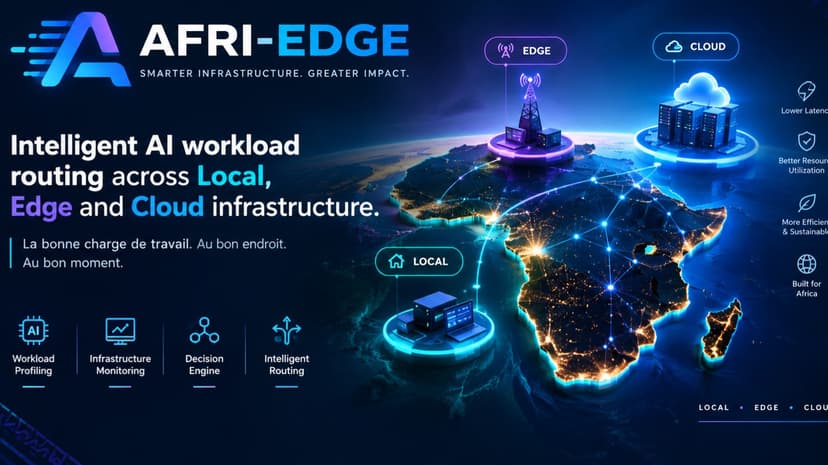
AFRI-EDGE
AFRI-EDGE is an intelligent infrastructure routing platform designed to optimize where AI and compute workloads run across Local, Edge, and Cloud environments. Instead of sending every workload to the cloud, AFRI-EDGE continuously evaluates available infrastructure conditions and workload requirements, then uses a Decision Engine to select the most appropriate execution target. The platform combines workload profiling, infrastructure monitoring, constraint-based candidate evaluation, and intelligent routing into a unified system. For each workload, the Decision Engine evaluates the available targets, ranks eligible candidates, and produces a transparent routing decision with a score and reasons behind the selection. AFRI-EDGE is designed with a practical African infrastructure context in mind, where connectivity, bandwidth, compute availability, latency, and resource constraints can vary significantly. By making infrastructure placement more adaptive, the project aims to provide a foundation for more efficient and resilient AI infrastructure. The current MVP includes an end-to-end routing flow, infrastructure state collection for LOCAL, EDGE, and CLOUD, workload profiling, candidate evaluation, and a dashboard for visualizing routing decisions and candidate rankings. Core principle: don't assume the cloud is always the right destination — evaluate the workload and the infrastructure, then route accordingly.
16 Sep 2026


