

Tyrell Overhiser@Null007Void
3
Events attended
2
Submissions made
United States
1 year of experience
About me
Independent builder exploring governed AI agents, autonomous workflows, and practical applications of open-source models. Focused on making AI systems more capable, accountable, and useful through thoughtful engineering and human oversight.
🤓 Latest Submissions

SourceCourt Exact Lite
SourceCourt Exact Lite is a bounded, evidence-first research assistant built for AMD AI League Match 4. It answers source-grounded questions while refusing to invent certainty when the available evidence does not support an exact answer. The system retrieves and parses bounded HTTP/HTTPS sources, interprets a user’s question, identifies relevant evidence, ranks candidate passages and links, and extracts an exact answer only when the evidence is sufficient. When the answer is ambiguous, unsupported, or unverifiable, SourceCourt refuses rather than fabricating a result. The project was hardened against unsafe retrieval behavior. Its transport layer rejects private and loopback network targets, protects against SSRF and DNS rebinding, preserves TLS hostname verification, limits redirects, constrains response size and timing, and avoids unsafe proxy behavior. It also includes bounded resource use, deterministic error handling, citation checks, and explicit ambiguity/refusal behavior. SourceCourt Exact Lite is packaged as a real command-line product. It can be installed as a Python package, run locally, or executed from a container image. The public release includes reproducible setup instructions, a deterministic demo, and a security-focused test suite. The release is provider-neutral at the model-adapter boundary, keeping retrieval, ranking, evidence extraction, citation, refusal, and safety logic independent from any single model provider while allowing the official Match 4 runtime or grader to supply the required model configuration. Container: `ghcr.io/null007void/sourcecourt-exact-lite:1.1.2` Digest: `sha256:39cd2d31e6fb95219da190d12a5620868e68293ac6ad88f8659142b744e4feec` SourceCourt Exact Lite returns the exact answer when the source supports it, shows the supporting evidence, and refuses when the result cannot be verified.
1 Dec 2026
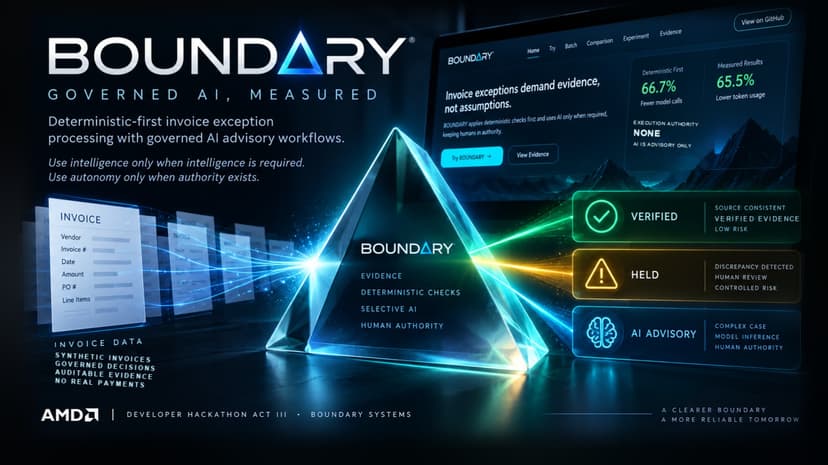
BOUNDARY — Governed AI, Measured
BOUNDARY is a working web application for finance and procurement teams: a governed, deterministic-first approach to handling synthetic invoice and purchase-order exceptions. Principle: Use intelligence only when intelligence is required. Use autonomy only when authority exists. An independently defined purchase-order fixture and supplier evidence feed input validation, deterministic classification, an independent guard, a simulated SQLite journal, and read-only verification. Exact matches resolve with zero model calls; missing evidence and amount discrepancies result in HOLD. Where interpretation is useful, AI advice is constrained and never grants payment authority (execution_authority = NONE). All data and actions are synthetic. Try BOUNDARY lets judges choose a scenario, edit invoice values, and inspect a newly calculated decision and evidence trace. The six-invoice batch and four-path comparison are explicitly labeled offline simulations. Public visitors cannot trigger paid inference. The AMD evidence is real and separately recorded: DeepSeek-V4-Flash and Google Gemma-4-31B-IT were tested through AMD Token Factory. Across 16 genuine requests on a limited synthetic workload, LLM-first used 12 calls/2,930 tokens versus BOUNDARY's 4 calls/1,010 tokens—66.7% fewer calls and ~65.5% fewer tokens. These are workload-specific inference reductions, not universal cost or accuracy claims. Serving-model identities remain unverified. A Gemma-only code-fence fix preceded an outage; Gemma was restored October 16. Evolus extraction and DeepSeek inference succeeded in an earlier partial integrated trial. On October 16, a separate live trial completed both Gemma paths using the same validated Evolus evidence, with source-consistent advice and execution_authority=NONE. The earlier trial remains partial. Built with FastAPI, SQLite, Docker, and Railway, BOUNDARY turns evidence, AI interpretation, and operational authority into independently inspectable boundaries.
18 Oct 2026


