Pathan Mohammed Sohail Abrar Khan@PMSAK
1
Events attended
1
Submissions made
India
1 year of experience
About me
I’m a B.Tech Computer Science student specializing in AI, with a strong interest in Artificial Intelligence, Machine Learning, LLMs, and AI Engineering. I enjoy learning by actually building things and getting my hands dirty with different technologies. I have worked with Python, machine learning and data science, and I’m currently focusing more on AI and LLM technologies. Outside of AI/ML, I also really enjoy game development. I’ve built and published 3D games using Unity and C#, working on everything from gameplay mechanics and player systems to UI, VFX, enemies, optimization, and game design. I’m someone who enjoys figuring things out, learning new technologies, and building projects along the way. Right now, I’m focused on growing as an AI Engineer and building projects that push my skills further.
🤓 Latest Submissions
Change Impact Investigator
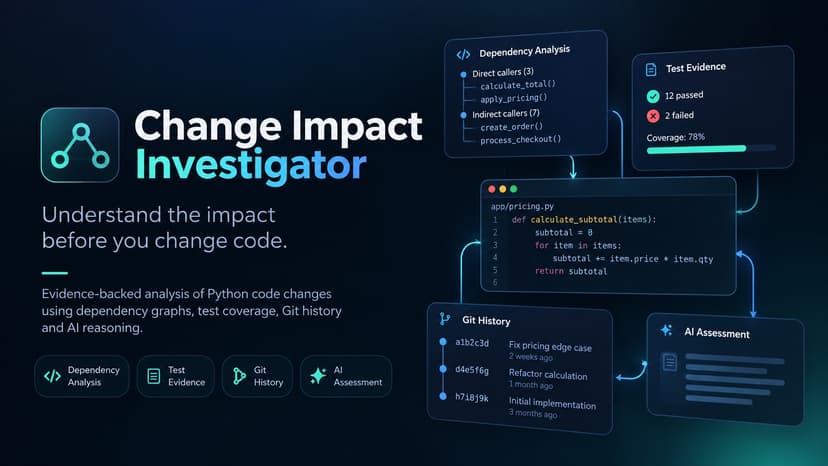
Software changes rarely affect only the lines being modified. A seemingly small change to a Python function can impact downstream callers, tests, and other parts of a repository in ways that are difficult to identify manually. Developers often have to rely on incomplete dependency information, search through tests themselves, and inspect Git history separately before deciding what needs to be investigated. Change Impact Investigator addresses this problem by providing an evidence-backed analysis of a proposed change in a Python repository. Instead of asking an AI model to simply guess the potential risk of a change, the system first gathers concrete evidence from the repository and then uses AI to reason over that evidence. The analysis begins with deterministic static analysis of the proposed target using Python's AST. It builds a function-level dependency and caller graph to identify direct and indirect relationships around the changed code. The system then examines the repository's test suite and uses coverage.py to determine which relevant code paths are actually exercised by tests. Finally, it analyzes Git history to provide additional context about how the affected code has evolved. These evidence sources are combined into a structured impact report containing the affected functions, direct and indirect callers, related tests, coverage information, potential coverage gaps, and relevant historical context. An AI reasoning layer then synthesizes these findings into a concise investigation report that explains what may be affected and what the developer should investigate before merging the change. The primary users are software developers and engineering teams working with Python repositories, particularly when reviewing pull requests or making changes to unfamiliar or interconnected code. The developer provides a GitHub repository and describes the proposed change, and the system performs the analysis automatically. What makes the project different is its focus on evidence over arbitrary AI-generated risk scores. The AI is not responsible for inventing dependencies or making unsupported assumptions; deterministic repository analysis provides the underlying evidence, while AI is used to interpret and communicate that evidence. This creates a more transparent and explainable workflow for understanding software change impact. The MVP combines Python AST analysis, dependency tracing, real test coverage analysis, Git history, and AI reasoning into a single workflow, helping developers understand the potential blast radius of a change before they merge it.
27 Sep 2026
