
🤝 Top Collaborators
🤓 Latest Submissions
ContractShield AI
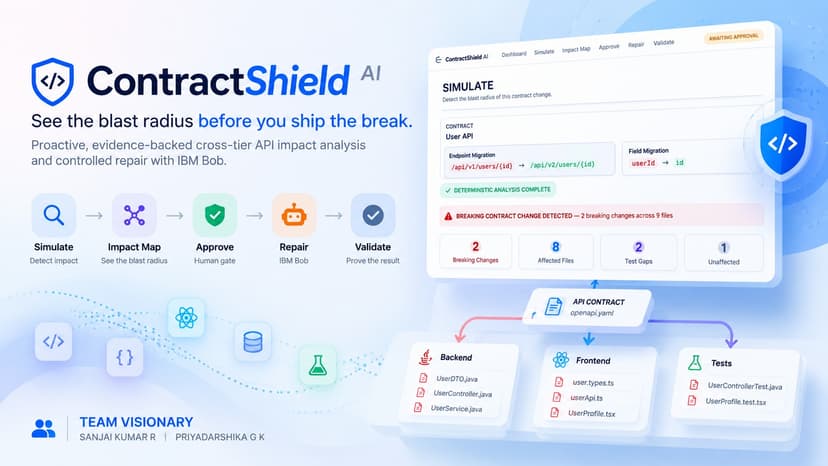
Modern software systems rarely break because of one file. A small API contract change can propagate across backend DTOs and controllers, frontend API clients and types, UI components, and tests. Developers often discover these dependencies only through repository-wide searching, manual inspection, repeated edits, and failures found late in the workflow. This creates missed dependencies, unnecessary rework, and slower releases. ContractShield AI transforms this reactive process into a controlled workflow: SIMULATE → IMPACT MAP → APPROVE → REPAIR → VALIDATE. The solution begins by analyzing a proposed API contract change before developers modify the code. ContractShield identifies affected files, direct references, potential impacts, test gaps, and unaffected areas. In our prototype, the demonstrated migration changes `/api/v1/users/{id}` to `/api/v2/users/{id}` and renames the response field `userId` to `id`. The Impact Map then presents the cross-tier dependency from the API contract through the backend, frontend, and tests. Rather than relying on unexplained AI confidence scores, ContractShield presents evidence such as direct references, changed contract fields, consumer references, and relevant test assertions. The key innovation is the human approval gate. Before repair begins, developers review the detected impact and explicitly approve the files that may be modified. This creates a controlled boundary for AI-assisted development rather than allowing unrestricted autonomous changes. Once approved, IBM Bob 2.0 supports semantic contract understanding, cross-tier reasoning, coordinated multi-file repair, and validation. Deterministic analysis complements Bob by handling exact references, file discovery, test-gap detection, supported change detection, and repair boundaries. This hybrid approach combines AI reasoning with traceable evidence and developer control. After repair, ContractShield validates the resulting state and clearly distinguishes verified results from checks that were not executed. This prevents unsupported success claims and keeps the final outcome transparent. The primary users are software developers, development teams, and engineers maintaining multi-tier applications with evolving APIs. Developers interact with ContractShield through a visual workflow that guides them from proposed contract change to impact analysis, approval, controlled repair, and validation. What makes ContractShield unique is that it does not start with “generate some code.” It starts with the contract and asks: “What could this change break, why is it affected, what should be changed, and what can we actually prove?” By combining IBM Bob 2.0 with deterministic analysis and human approval, ContractShield turns API evolution from reactive debugging into an evidence-driven engineering workflow. Our core principle is simple: understand the blast radius first, approve the change, repair with control, and prove the result before shipping.
27 Sep 2026
