

🤓 Latest Submissions
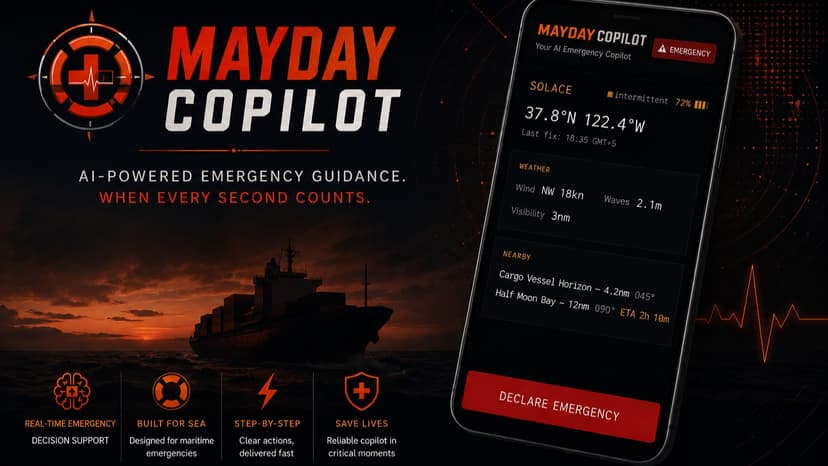
Mayday Copilot
Solo sailors face genuine life-threatening emergencies —> flooding, engine failure, medical crises — often with no cell signal and no crew to consult. In the critical first minutes, knowing the correct distress protocol (MAYDAY vs. PAN-PAN), the right actions, and exactly what to say on VHF Channel 16 can mean the difference between a controlled response and panic. Most sailors only have general safety training, hard to recall clearly under stress. Mayday Copilot is an AI emergency assistant for solo and short-handed sailors — recreational or coastal cruisers without a full crew, satellite phone, or professional rescue coordination on hand. Instead of typing during a crisis, the sailor taps through a 3-step intake (what's happening, is anyone injured, is the vessel taking on water). Based on the combination of answers, the app determines whether the situation is a MAYDAY or PAN-PAN, shows an instant baseline instruction so there's never a blank screen, then streams live, situation-specific AI guidance. The sailor can then generate the exact radio script — pre-filled with vessel name and position — revealed line by line for reading aloud on Channel 16. Mayday Copilot was built entirely on native.builder, from a single natural-language brief through to a deployed application. The Product Architect agent scoped the MVP into a defined feature set (Home, Intake, Copilot, and Radio Script screens), the Task Planner broke that into dependency-ordered build tasks, and the Builder agent generated the full Vite + React + Tailwind app from those tasks. Live AI guidance was wired in via OpenRouter's chat completions API with a system prompt defining the assistant's maritime-safety behavior, streamed directly into the Copilot screen. Iterative fixes — state persistence across screens, navigation scroll behavior, an instant-response fallback for perceived latency — were made in native.builder's code editor and redeployed via Publish and GitHub Sync.
10 Aug 2026
