
🤝 Top Collaborators
🤓 Latest Submissions
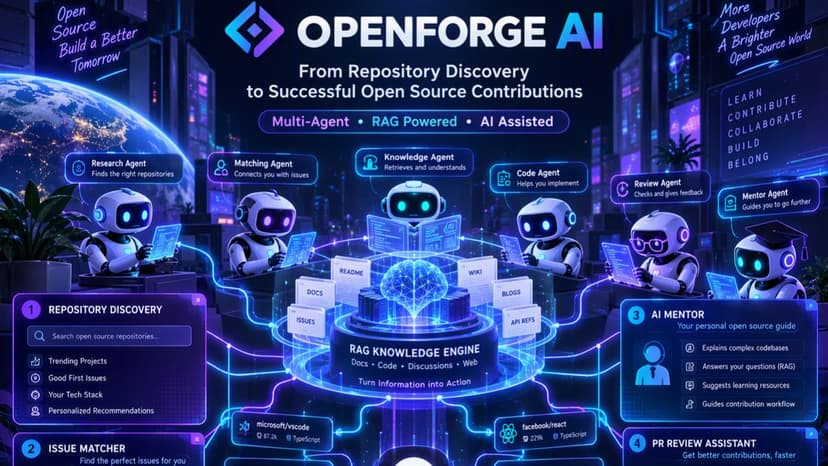
OpenForge AI: Open Source Contribution Platform
OpenForge AI is an AI-powered multi-agent platform designed to simplify open-source contribution and accelerate developer onboarding. Many developers, especially students and first-time contributors, struggle to find suitable repositories, understand unfamiliar codebases, identify beginner-friendly issues, and navigate contribution workflows. OpenForge AI addresses these challenges through an intelligent ecosystem of specialized AI agents that analyze repositories and provide contextual assistance throughout the contribution journey. The platform begins with a Repository Discovery Agent, which searches and evaluates open-source repositories based on a developer's interests, programming languages, skill level, and contribution goals. Instead of manually browsing thousands of repositories, users receive AI-curated recommendations with repository health metrics, activity analysis, technology stack information, and contribution potential. Key Features: AI-powered repository discovery Intelligent issue recommendation Repository architecture understanding Automated documentation generation Vector-based repository knowledge system RAG-powered codebase question answering AI mentor for contributor guidance Pull request review assistance Multi-agent workflow orchestration Scalable LLM integration layer
18 Oct 2026
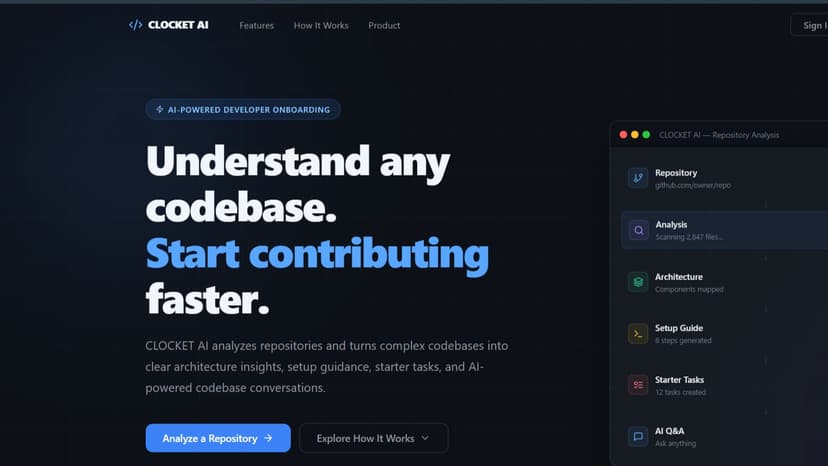
Clocket AI – Smart Developer Onboarding Assistant
## Problem Joining an unfamiliar software project can take hours or even days. Developers must manually understand the repository structure, technology stack, architecture, dependencies, environment configuration, APIs, database usage, and contribution workflow. README files may be incomplete or outdated, making the onboarding process slow and difficult, especially for new developers. ## Solution Clocket AI is a Smart Developer Onboarding Assistant that automatically analyzes a public GitHub repository and converts the codebase into an interactive onboarding experience. A developer signs in, provides a GitHub repository URL, and starts an automated analysis. Clocket AI validates and scans the repository, detects its technologies and configuration, analyzes the architecture, generates an evidence-based setup guide, creates practical starter tasks, indexes relevant source files into a repository-scoped RAG system, and stores the results for the user. Developers can then explore the generated architecture, follow setup instructions, work through beginner/intermediate/advanced starter tasks, track their onboarding progress, and ask natural-language questions about the codebase. Answers are grounded in retrieved repository files and include source citations. ## Target Users The primary users are developers joining unfamiliar projects, interns, students learning existing codebases, engineering teams onboarding new members, and maintainers who want to make repositories easier to understand. ## Technology and Architecture The application uses a React/Vite frontend and FastAPI backend. LangGraph orchestrates a multi-stage analysis workflow including repository validation, cloning, deterministic static scanning, architecture analysis, setup-guide generation, onboarding-plan generation, task generation, RAG indexing, persistence, and cleanup. The system combines deterministic analysis with LLM reasoning rather than relying entirely on an LLM. Repository files are chunked and embedded using fastembed and stored in Supabase PostgreSQL with pgvector. Retrieval is filtered by both user and repository to maintain data isolation. Clocket AI also integrates the official GitHub MCP Server for repository access and custom MCP tools for saving analysis results and managing onboarding progress. ## What Makes It Unique Instead of simply generating a README or chatbot response, Clocket AI creates a complete, interactive onboarding workflow from the actual codebase. It combines repository analysis, Agentic RAG, MCP tools, architecture explanation, evidence-based setup instructions, actionable starter tasks, and progress tracking in one system. Security is also built into the architecture through Supabase authentication, Row Level Security, repository-scoped retrieval, server-side secrets, read-only GitHub MCP access, file-size limits, and prompt-injection-resistant handling of repository content. The application is deployed and available as a web application, making the onboarding workflow accessible without requiring developers to manually configure the system locally.
27 Sep 2026


