
🤝 Top Collaborators

🤓 Latest Submissions
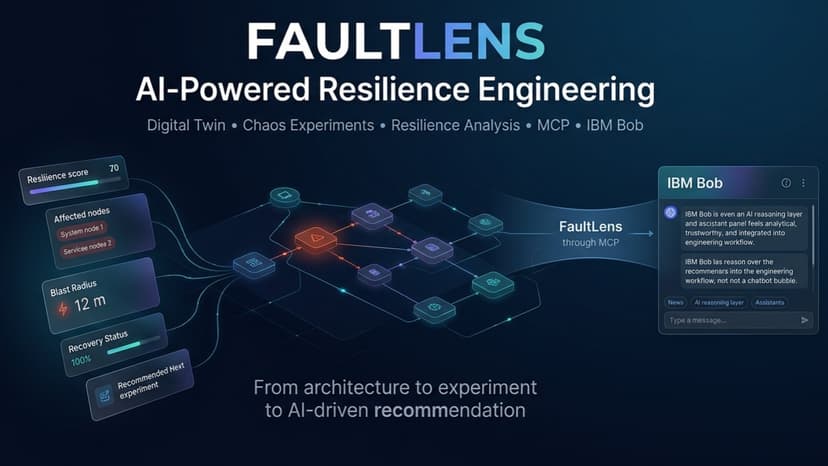
FaultLens — AI-Powered Resilience Engineering
FaultLens is an AI-assisted Chaos Engineering and Resilience Intelligence platform designed to help developers understand how distributed systems behave when failures occur. Modern applications are composed of many interconnected services, databases, queues, gateways, and dependencies. A failure in one component can propagate through the architecture in ways that are difficult to predict before production. Traditional monitoring often tells engineers what failed after the incident; FaultLens focuses on understanding how failures propagate and what engineers should investigate next. Users import a system architecture into FaultLens, which validates the topology and creates a simulation-ready Digital Twin represented as an interactive dependency graph. Engineers can select components and execute safe, simulated ChaosLab experiments such as service failures, latency spikes, and resource-related disruptions without touching real production infrastructure. FaultLens models failure propagation through actual system dependencies and produces experiment-specific metrics including affected nodes, blast radius, recovery behavior, metric impact, risk level, and a resilience score. Experiment parameters have real consequences in the simulation: for example, running the same failure for 10, 30, and 60 seconds can produce progressively different propagation and recovery outcomes. The platform then builds a structured FaultLensContext containing the system architecture, experiment configuration, propagation path, recovery data, resilience analysis, history, and recommendations. Through a real Model Context Protocol (MCP) integration, IBM Bob can access this context and FaultLens tools directly. Bob can inspect the latest experiment, reason about why the failure propagated, interpret the resilience result, identify critical recovery problems, and recommend the most useful next chaos experiment. This creates a continuous workflow: Architecture → Digital Twin → Chaos Experiment → Failure Propagation → Metrics → Resilience → MCP → IBM Bob → Reasoning → Recommendation FaultLens combines deterministic engineering evidence with AI reasoning: FaultLens generates the evidence; IBM Bob reasons over the evidence.
27 Sep 2026

PulseCity AI – Real-Time Urban Intelligence System
PulseCity AI is an urban intelligence platform designed to create a living digital twin of modern cities. The system combines real-time environmental data, live weather conditions, traffic analytics, and AI-powered monitoring into an interactive visualization environment. The platform focuses on Shibuya, Tokyo, using geospatial technologies and digital twin concepts to represent city activity in a dynamic and immersive way. PulseCity AI integrates Cesium for geospatial visualization and Unreal Engine for advanced city rendering, enabling users to explore urban conditions through an intelligent interface. The system retrieves live weather information, traffic flow analytics, congestion hotspots, and environmental indicators from external APIs and displays them inside a futuristic dashboard designed for smart-city operations. Key capabilities include: • Real-time weather monitoring for Shibuya • Traffic hotspot detection using live traffic APIs • Congestion visualization layers • AI-driven urban monitoring interface • Smart city telemetry dashboard • Digital twin visualization workflow • Interactive geospatial environment using Cesium and Unreal Engine PulseCity AI aims to demonstrate how AI and digital twins can support future urban management, decision-making, and city intelligence systems.
17 May 2026


