
🤝 Top Collaborators

🤓 Latest Submissions
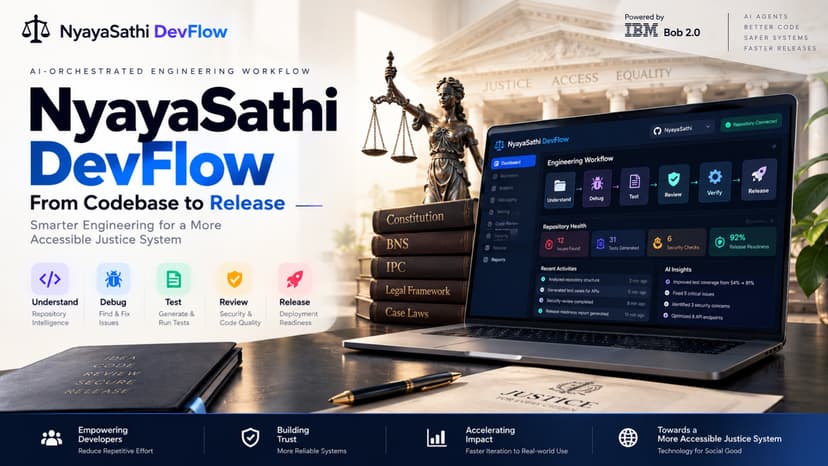
NyayaSathi DevFlow
Modern AI applications are no longer simple codebases. They combine frontend applications, backend APIs, databases, external services, AI pipelines, dependencies, authentication, and configuration. As these systems evolve, developers spend significant time understanding repositories, locating bugs, writing tests, reviewing changes, investigating security issues, and validating whether a change is safe to release. NyayaSathi DevFlow addresses this problem by turning IBM Bob 2.0 into an AI-powered engineering workflow for the NyayaSathi platform. NyayaSathi is an AI-powered legal assistance application with intelligent legal information retrieval, document generation, multilingual assistance, and backend services. Its multi-component architecture provides a realistic environment for demonstrating how AI can assist developers throughout the software lifecycle. Instead of treating Bob as a simple coding chatbot, NyayaSathi DevFlow uses its agentic capabilities to coordinate a sequence of engineering tasks. The workflow begins with repository understanding, where Bob analyzes the project structure, dependencies, important modules, APIs, documentation, and configuration. Specialized tasks can then investigate bugs, identify missing test coverage, generate tests, review code, inspect security risks, and validate fixes. Parallel tasks and subagents allow different areas of the project to be investigated independently before their findings are consolidated. The developer interacts with the system through an engineering dashboard where they can initiate an audit, inspect findings, review AI-generated recommendations, execute tests, and track release readiness. Rather than replacing the developer, the system reduces repetitive investigation and verification work while keeping the developer in control of code changes and final decisions. The final workflow transforms a repository from an unfamiliar codebase into an actionable engineering report: understand the system, identify issues, generate or improve tests, review changes, verify fixes, and assess release readiness. The prototype demonstrates how IBM Bob 2.0 can move beyond code generation toward an orchestrated software-engineering workflow that improves developer productivity, reduces repetitive effort, and helps teams maintain complex AI-powered applications more systematically.
27 Sep 2026
