

🤝 Top Collaborators

🤓 Latest Submissions
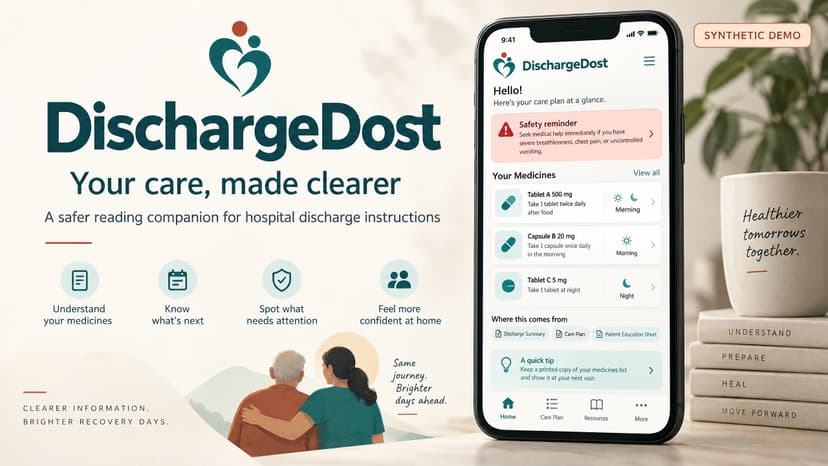
DischargeDost — Your Care, Made Clearer
Discharge instructions can be difficult to read, especially when they contain medical abbreviations, handwritten medication details, unclear schedules, or unfamiliar clinical language. DischargeDost is a safety-first prototype designed to make those instructions easier for patients and caregivers to navigate. It organizes information into clear sections for medicines, warning signs, food and activity, and follow-up steps. Each displayed item remains connected to its original source line, while unclear or high-risk information is visibly flagged instead of being silently guessed. The prototype includes: A patient-friendly care-plan view English and Hindi interface content Medicine timing and frequency organization Original source-line references Confidence and uncertainty indicators Warning-sign and emergency information Browser-based read-aloud support Print/save-to-PDF support WhatsApp checklist sharing Follow-up calendar reminder download A simulated staff-review experience RED safety triage for ambiguous or high-risk information This version intentionally uses fictional synthetic data only. It does not process real medical documents, provide medical advice, perform OCR, or replace a qualified clinician. The goal of the prototype is to demonstrate a safer interaction model for future discharge-document tools: show the source, preserve uncertainty, and keep human review visible.
18 Oct 2026
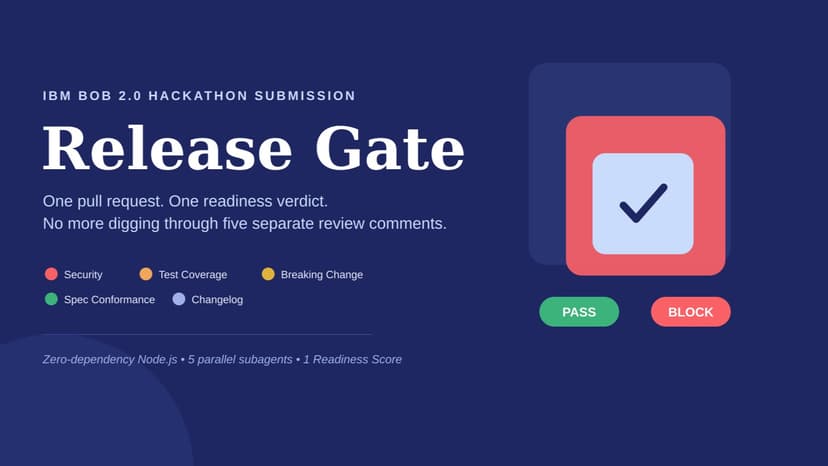
Release Gate
Release Gate is a hackathon submission (built for the "IBM Bob 2.0" hackathon) that automates PR/release readiness review. Instead of a reviewer skimming a large diff and missing a dangerous line, or burning an hour reading every line of a trivial change, Release Gate runs five isolated subagents in parallel against the PR: Security & Risk — flags hardcoded secrets/keys, unsafe calls (eval, child_process), and risky dependency bumps Test Coverage — checks whether changed source files have matching test changes in the same diff Breaking Change Trace — detects exported functions/classes/consts that were removed with no replacement Spec Conformance — checks the PR's changes against a supplied spec/design doc's stated requirements Changelog Draft — drafts a changelog entry from the PR title and changed files (informational, non-blocking) Each subagent returns a compact { status, score, findings } result rather than raw noise, and a weighted aggregator merges these into one Readiness Score and a single aggregated report, replacing what would otherwise be five separate bot comments. It's a zero-dependency Node.js 18+ project (uses only built-in fetch/fs) with: an offline demo (node src/index.js demo) using fixture data that deliberately contains a hardcoded secret, a removed legacy function, an unnoted dependency bump, and no test changes — catching all four in one pass with a 12/100 BLOCK verdict a real-PR gate mode (node src/index.js gate <prNumber> <owner> <repo>) that works against the GitHub REST API, optionally against a spec file, and can post the report as a PR comment a background scan mode (node src/background.js <owner> <repo>) that gates every open PR in a repo and ranks them by risk The repo also includes a submission/ folder with hackathon materials (project brief, architecture doc, setup guide, demo script, impact metrics, and a pitch deck), plus a demo/ folder with a supporting HTML page. If you'd like, I can tailor these further (e.g., a one-line tagline for a listing page, or a more marketing-style pitch based on the submission materials).
27 Sep 2026

