
🤝 Top Collaborators




🤓 Latest Submissions

LogPilot
Modern applications generate enormous amounts of logs, but when something starts failing, engineers often have to manually search through thousands of log lines, correlate errors across services, identify the root cause, and decide what to do next. Traditional monitoring can tell a team that something is wrong, but it often does not explain why it is happening or provide enough context to act before an incident becomes severe. LogPilot addresses this gap by turning raw application logs into a continuously updated picture of system health, risk, and likely failure. LogPilot is an autonomous log-intelligence agent that continuously ingests, parses, redacts, indexes, and analyzes logs from live services. It combines deterministic statistics and machine-learning algorithms with an agentic AI layer. Error velocity, baseline deviation, historical incident similarity, anomaly detection, DBSCAN clustering, and Isolation Forest are computed by the platform itself rather than guessed by an LLM. Root-cause analysis uses lagged Pearson correlation between service error time-series and trace-ID relationships to construct a causal chain. The AI then explains these already-computed results in natural language rather than inventing metrics or evidence. LogPilot also provides proactive failure forecasting. Services are continuously rescored on a roughly five-second cadence, allowing the platform to identify rising failure risk and generate pre-incident alerts and pre-mortems. Its conversational interface is genuinely agentic: instead of matching questions to fixed rules, the reasoning model receives the available tool catalogue and decides which tools to call, in what order, and how many times. For example, a question about a failing Redis service can cause the agent to independently combine root-cause analysis with targeted log searches before producing an answer. To demonstrate the complete system in action, we built a separate demo e-commerce platform that generates realistic application activity and failures, with its logs continuously streamed into LogPilot in real time. We use Locust to generate sustained concurrent traffic against the platform, allowing LogPilot to continuously observe fresh live logs and demonstrate the complete detect, analyze, forecast and explain workflow on real system activity rather than a scripted dataset.
27 Sep 2026
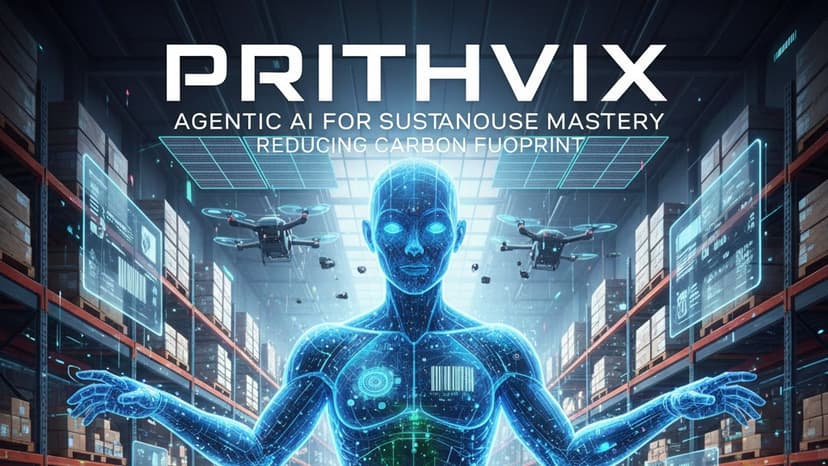
PrithviX
PrithviX is an Adaptive AI-Driven Warehouse and Trend Forecasting System that transforms inventory management through automation, sustainability intelligence, and explainable analytics. Built on IBM Watsonx Orchestrate, it unifies social-trend detection, demand forecasting, supply-chain awareness, waste analysis, and risk simulation into one automated workflow. The process begins when Orchestrate activates PrithviX’s social-signal engine, which collects anonymized trend patterns from TikTok, Instagram, and YouTube. These signals are cleaned and validated to separate real demand from short-term hype. The refined signals, combined with historical sales logs, feed into the forecasting engine to produce short- and medium-term predictions. SHAP explainability reveals which factors influence each forecast, increasing clarity and trust. Orchestrate then connects these predictions to the supply-availability agent, which evaluates stock levels, shipment delays, expiry risks, and supplier reliability. This ensures insights match real operational constraints. PrithviX’s sustainability module analyzes carbon footprint, packaging impact, waste probability, and deadstock risk to support responsible decisions. A simulation engine models thousands of possible outcomes, estimating risks related to overstocking, lost revenue, waste generation, and environmental impact. All outputs flow into an XAI decision card presenting trends, supply feasibility, sustainability impact, and risk levels. Managers receive one clear recommendation: stock more, stock less, or wait. PrithviX stands out by combining trend intelligence, forecasting, supply logic, sustainability scoring, and risk modeling into a single orchestrated ecosystem. It supports SDG 9 by modernizing warehouse operations, SDG 12 by reducing waste, and SDG 17 by integrating with ERP systems like SAP and Oracle. The result is a smart, transparent, and sustainable warehouse intelligence platform.
23 Nov 2025

