

Simran Sodagar@SimranCipher
2
Events attended
2
Submissions made
Pakistan
1 year of experience
About me
I am a BS Biochemistry student with a strong interest in research, technology, innovation, and AI integration. I am curious about the intersection of science and technology. By participating in hackathons, I am gaining practical experience in transforming ideas into operational applications while learning from collaborative, multidisciplinary teams. "Learning today to innovate tomorrow". 🌟
🤝 Top Collaborators



🤓 Latest Submissions
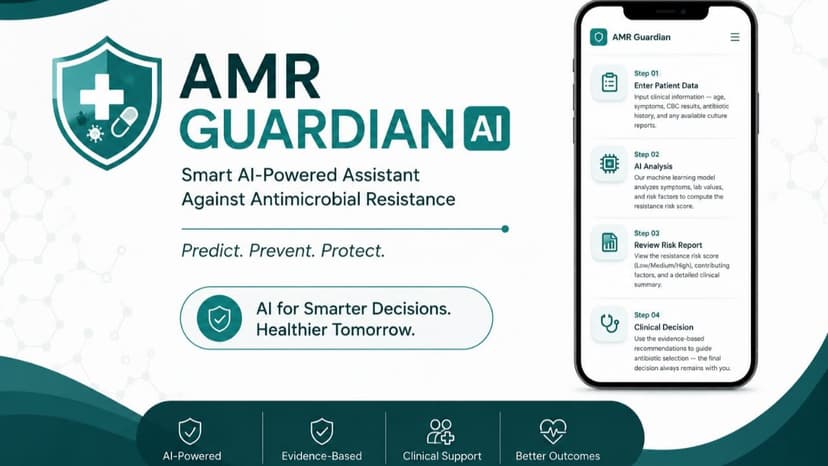
AMR Guardian AI Antimicrobial Resistance Predictor
AMR Guardian AI is an AI powered clinical decision support system designed to help healthcare professionals identify and assess the risk of antimicrobial resistance at an early stage. The project addresses a critical healthcare challenge where inappropriate or unnecessary antibiotic use can contribute to the development and spread of resistant infections. The system analyzes multiple patient specific factors, including age, symptoms, basic laboratory results, previous antibiotic use, and culture information. It combines these inputs to generate an antimicrobial resistance risk assessment and presents the results through a clear, user friendly dashboard. The platform provides a risk score, risk level, infection category, severity assessment, clinical summary, confidence score, key findings, major risk factors, and feature importance. It also provides culture testing, follow up, isolation, and antibiotic stewardship recommendations. These explainable outputs help users understand why a patient may have an elevated resistance risk instead of receiving a simple unexplained prediction. AMR Guardian AI uses React for the frontend, Supabase for authentication and database management, and AI powered analysis for generating clinically relevant insights. The dashboard presents patient analyses, AMR risk trends, infection distributions, and recent assessment records in an organized interface. The project is designed as a decision support prototype. Its purpose is to demonstrate how AI can support earlier risk assessment, improve antimicrobial stewardship, and encourage more informed antibiotic use. AMR Guardian AI combines biotechnology, clinical data analysis, artificial intelligence, and modern web development into one practical solution. It demonstrates how intelligent data driven tools can support healthcare professionals in addressing antimicrobial resistance and building more responsible approaches to antibiotic treatment.
10 Aug 2026
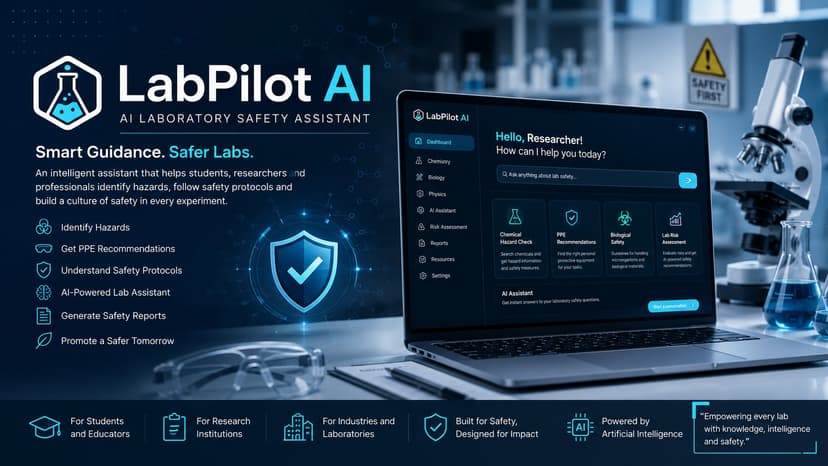
LabPiolet AI
LabPilot AI is an AI powered Laboratory Safety Assistant designed to improve safety, hazard awareness. It addresses a common problem where students and researchers often lack immediate access to accurate laboratory safety guidance while handling chemicals, biological materials, and laboratory equipment. By combining scientific knowledge with artificial intelligence, the platform delivers quick, reliable, and user friendly safety assistance to help reduce laboratory accidents. The project's aim is to promote safer laboratory practices through intelligent guidance. Its objectives include identifying chemical hazards, recommending appropriate Personal Protective Equipment (PPE), providing biology and physics safety guidance, supporting laboratory risk assessment, generating safety reports, and answering laboratory related questions through an AI assistant. Key features include AI powered laboratory consultation, chemical hazard search, PPE recommendations, chemistry, biology and physics safety modules, laboratory safety reports, dashboard analytics, voice search prototype, downloadable reports, and a simple, responsive interface for students and researchers. LabPilot AI was developed using HTML, CSS, JavaScript, Node.js, Express.js, REST APIs, Git, GitHub, and Fireworks AI for language model integration. Building the project required extensive effort in frontend and backend development, AI integration. The vision is to evolve LabPilot AI into a digital laboratory companion for universities, research institutions, pharmaceutical and biotechnology industries. Future versions will include multilingual support, image based hazard detection, Safety Data Sheet integration, cloud databases, experiment risk prediction, and laboratory monitoring. The project demonstrates how artificial intelligence can enhance laboratory education, improve compliance with safety standards, reduce human error, and create safer research environments through accessible and intelligent technology.
13 Jul 2026


