
🤝 Top Collaborators

🤓 Latest Submissions
DevTwin — AI Change Impact Simulator
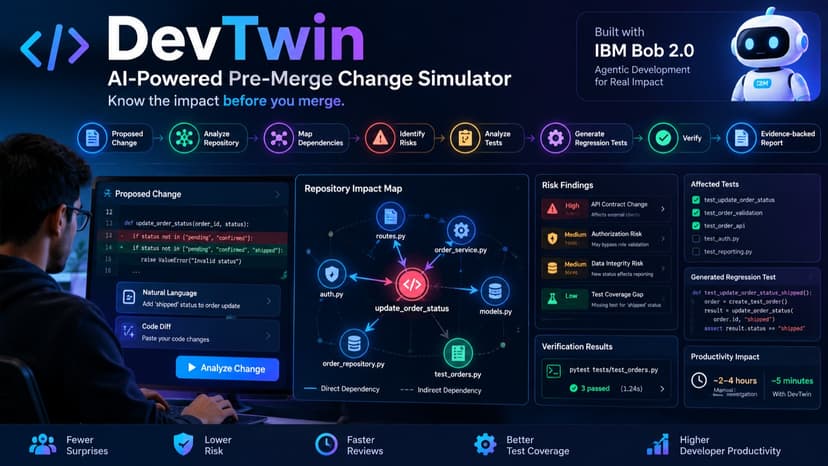
Software changes that look small can create large and hidden consequences. A developer may modify one function, API, or component, but discovering everything affected by that change often requires manually searching the repository, tracing dependencies, checking documentation, finding relevant tests, predicting risks, writing regression tests, and running validation. This makes the pre-merge workflow time-consuming and increases the chance of missed dependencies, inadequate test coverage, and late discovery of defects. DevTwin is an AI-powered software change simulator designed to move this discovery process earlier—before a change reaches production. A developer starts by selecting a project and providing a proposed code change through a natural-language description or code diff. DevTwin analyzes the change in the context of the project and produces a complete change-impact view. The solution identifies directly and indirectly affected files, functions, and components and visualizes them as a blast-radius map. It then analyzes potential regression, API/contract, security, data, performance, and maintainability risks and explains why each finding matters using evidence from the project. DevTwin also analyzes the testing impact of the proposed change. It identifies relevant existing tests, highlights important coverage gaps, and generates focused regression tests for high-value scenarios. The proposed change can then be verified using the project's available validation checks, with the actual results shown in the final report. The target users are software developers, engineering teams, and reviewers who need to understand the consequences of code changes before merging them. What makes DevTwin different is that it is not simply an AI coding assistant. Traditional coding assistants primarily help developers write or modify code. DevTwin focuses on understanding the consequences of that change. It combines change-impact analysis, risk identification, test intelligence, documentation context, test generation, and verification into one pre-merge workflow. The solution also demonstrates an agentic approach: independent analysis tasks for dependencies, risks, tests, and project documentation can be coordinated and performed in parallel before their findings are synthesized into a single report. The result is a proactive developer workflow: Propose Change → Analyze Impact → Identify Risks → Find Test Gaps → Generate Tests → Verify → Report. DevTwin aims to reduce repetitive manual investigation, discover risks earlier, reduce rework, and give developers stronger evidence before they merge a change. Our core idea is simple: instead of discovering the consequences of a code change after something breaks, understand those consequences before the change reaches production.
27 Sep 2026

