
🤓 Latest Submissions

DubGuard: Evidence Backed Narration Review
In industrial training and maintenance videos, one wrong word can change an entire instruction. “Switch the power off” becomes “switch the power on.” A 15-minute wait becomes 50 minutes. Comparing transcripts can reveal these differences, but knowing whether a change is an acceptable paraphrase or alters a critical requirement takes closer review. DubGuard helps reviewers make that distinction, with evidence they can check. Users can explore predefined scenarios or add their own reference scripts and mark requirements that need particular attention, such as numbers, warnings, on/off instructions and the order of steps. They then record or upload English narration. DubGuard keeps the original audio and uses Whisper, running locally on the CPU, to produce a timestamped draft transcript. Rule-based checks flag possible deviations and areas of uncertainty for review. For an additional perspective, users can choose to enable semantic analysis through AMD Token Factory using DeepSeek-V4-Flash. This sends only the script, review policy and transcript text—not the original audio. DubGuard checks that the returned citations match exact passages in the source text, and treats the model’s findings as advisory. Reviewers can listen to the audio, inspect flagged passages, correct transcription mistakes, document their decisions and export the results. Organizational sign-off remains with an authorized human reviewer, and critical findings or unresolved evidence cannot be automatically approved. Built with React, TypeScript, FastAPI, SQLite and Whisper, DubGuard helps people review industrial narration more consistently and keep a clear record of their decisions. It supports human judgment; it does not certify that an instruction is safe.
18 Oct 2026
Tomato Irrigation & Disease Digital Twin
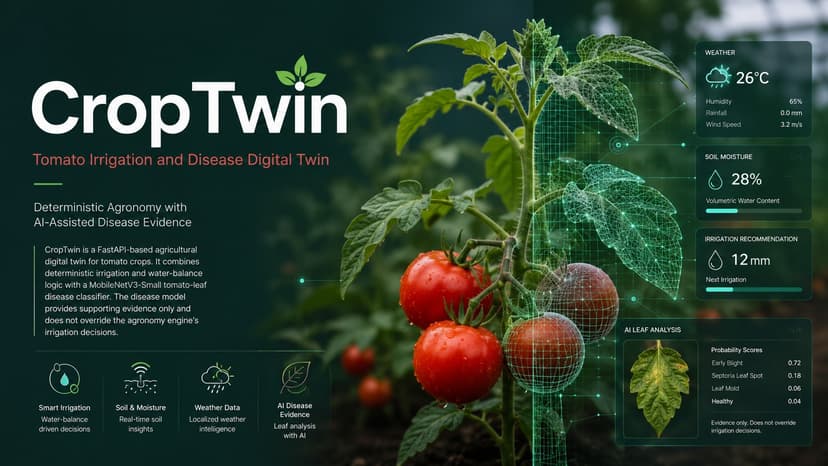
CropTwin is a tomato irrigation and disease digital twin designed to support safer and more explainable irrigation decisions. It maintains a session-based digital representation of a tomato crop using planting date, location, soil texture, weather inputs, crop growth stage, water balance, and tomato-leaf disease evidence. The deterministic agronomy engine calculates reference evapotranspiration, crop water use, root-zone depletion, moisture state, and crop-stress conditions. It then simulates multiple irrigation actions, including irrigating immediately, irrigating later, irrigating the following morning, or delaying irrigation for 24 hours. Based on these simulations, the system selects a deterministic irrigation recommendation and provides structured reasons for the decision. A fine-tuned MobileNetV3-Small classifier analyses uploaded tomato-leaf images and returns disease evidence, calibrated confidence, and an uncertainty level. The classifier does not directly choose the irrigation action; it only contributes supporting evidence and possible caution signals. CropTwin includes a FastAPI backend, a Streamlit frontend, session history, action simulation, recommendation generation, and farmer-readable explanations. It is an MVP decision-support tool and does not replace field inspection or professional agronomic advice.
13 Jul 2026


