
🤓 Latest Submissions

Z-Forge
### Problem & Solution Statement IBM Z applications are built from tightly coupled artifacts—COBOL programs, copybooks, HLASM/DSECTs, JCL, datasets, and downstream outputs. A seemingly simple change, such as expanding a `CUSTOMER-ID` field from 8 to 12 bytes, can introduce hidden truncation, interface mismatches, or downstream failures that are difficult to discover through file-by-file editing. **Z-FORGE** is an AI change-engineering platform for IBM Z that turns this risky process into a structured, evidence-driven workflow. IBM Bob acts as the AI development agent and orchestrates Z-FORGE through MCP, while Z-FORGE provides mainframe-specific dependency analysis and deterministic validation. A user submits a change request such as **“Expand CUSTOMER-ID from 8 bytes to 12 bytes.”** Z-FORGE analyzes the workspace, builds a dependency-aware blast radius, identifies affected artifacts, and proposes the required changes. The proposed changes are then validated independently rather than simply being accepted because an AI agent generated them. Our workflow deliberately includes adversarial validation. In the demonstration, the initial proposal changes the primary field to 12 bytes but leaves a local `PIC X(8)` field unchanged. Deterministic validation detects the resulting data-truncation risk, while the adversarial critic independently identifies the hidden inconsistency. Z-FORGE then applies targeted remediation in a new immutable snapshot and re-runs validation until the result passes. The system also generates tamper-evident evidence describing the change, impacted artifacts, validation failures, adversarial findings, remediation, and final verification. Original imported artifacts remain unchanged. Downstream impact can extend beyond source code to generated outputs such as AFP print reports, allowing users to inspect how a change propagates through the wider application workflow. **Target users** include IBM Z developers, modernization teams, application maintainers, QA engineers, and organizations responsible for safely evolving legacy mainframe applications. What makes Z-FORGE distinctive is the combination of **IBM Bob + MCP + mainframe-aware dependency intelligence + deterministic validation + adversarial review + auditable evidence**. Instead of asking AI to simply modify code and declare success, Z-FORGE requires the proposed change to survive independent checks and produce evidence that it is correct. The result is a repeatable change-engineering workflow: **Import → Analyze → Map Dependencies → Propose → Validate → Attack → Remediate → Prove** Z-FORGE's core principle is simple: **AI doesn't get to say “fixed.” It has to prove the result.**
27 Sep 2026
BeeKeeper
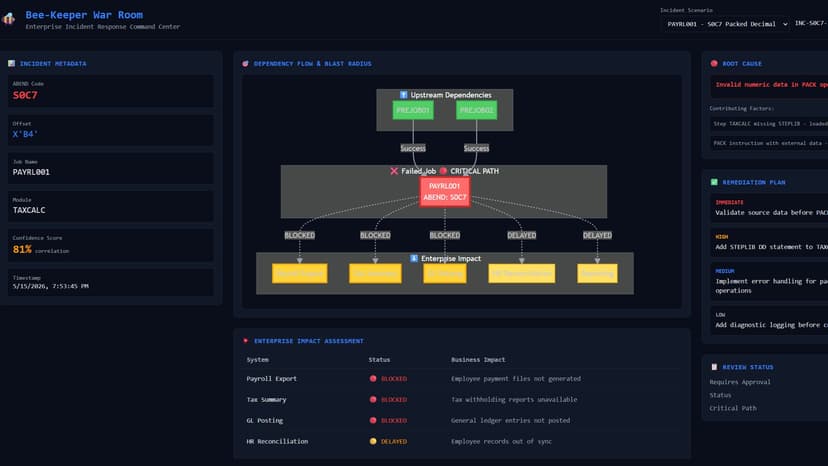
Bee-Keeper is an enterprise forensic intelligence platform built on top of IBM Bob to modernize how organizations diagnose and recover from legacy mainframe incidents. Instead of treating IBM Bob as a generic coding assistant, Bee-Keeper extends Bob through MCP-powered operational workflows that provide deep forensic reasoning for JCL, Assembler, and ABEND analysis. When a production incident occurs, Bee-Keeper launches a multi-stage forensic workflow that analyzes JCL topology, correlates assembler execution patterns, traces ABEND memory offsets, and generates confidence-scored Root Cause Analysis reports with operational blast-radius visualization. The platform also maintains “Operational Knowledge Continuity” by learning from historical incidents and surfacing prior recovery insights, trends, and remediation patterns. Bee-Keeper includes an enterprise Incident War Room dashboard with Mermaid-based dependency visualization, AI-orchestrated recovery planning, human-in-the-loop review checkpoints, and multi-agent workflow coordination inspired by watsonx Orchestrate. The system demonstrates how IBM Bob can evolve from a development assistant into an enterprise operational intelligence platform capable of reducing mainframe incident recovery from days to minutes.
17 May 2026


