

🤝 Top Collaborators



🤓 Latest Submissions

ReviewMate
The Problem Code review is slow and inconsistent. Reviewers check security, test coverage, and code quality separately — often one dimension at a time — and writing up a clear, actionable summary can take as long as the review itself. Under time pressure, things slip through: a missing auth check, an untested destructive endpoint, a validation gap nobody flagged. Junior engineers in particular need context, not just a pass/fail verdict, and senior reviewers rarely have time to provide it consistently. The Solution ReviewMate is an intelligent code review coach built on IBM Bob 2.0. It uses Bob's Agent mode to run four specialized analysis passes against a codebase: - A security subagent that flags injection risks, missing authentication, and unsafe input handling - A test coverage subagent that maps every function against the existing test suite and identifies untested branches - A complexity/style subagent that flags maintainability issues and REST-convention gaps - A synthesis subagent that merges all three into a single ranked report with a clear recommendation (approve / approve with comments / request changes) The output is presented through a Streamlit web app styled after real PR review tools — color-coded severity badges, a summary card, and an expandable full report — so the findings read like something a development team would actually use, not a raw log dump. Target Users Engineering teams and individual developers who want consistent, multi-dimensional code review without needing a senior engineer to manually check security, tests, and quality separately on every pull request. It's especially valuable for smaller teams or solo developers who don't have a dedicated security or QA reviewer on every PR. How Users Interact With It A developer points Bob IDE at their repository and runs the four subagent analyses (individually or, in a production setup, in parallel via Agent mode) against a specific PR or diff. Bob's findings are saved and rendered through ReviewMate's Streamlit interface, giving a clear, shareable report: what's wrong, where, how severe, and what to do about it. What Makes It Creative and Unique Rather than treating code review as a single monolithic task, ReviewMate decomposes it into specialized subagents — mirroring how a real review team would split responsibilities across a security reviewer, a QA engineer, and a code quality reviewer — then uses a synthesis pass to merge their findings into one coherent recommendation, the way a tech lead would summarize a review for the team. This demonstrates Bob 2.0's ability to reason with full repository context, not just the changed lines, catching issues (like a missing REST convention or duplicated logic elsewhere in the codebase) that a diff-only tool would miss entirely. Effectiveness On our demo pull request, Bob's four subagents identified 4 security findings (2 high severity, including a complete missing-authentication gap), 3 test coverage gaps, and 4 code quality issues — producing a "Request Changes" verdict with specific required fixes. Bob's own estimate: roughly 50 minutes saved compared to a thorough manual review across all three dimensions, primarily through systematic completeness rather than raw speed — no category gets skipped because a reviewer ran out of time or attention.
27 Sep 2026

GenomeAtlas AI™ – Mapping Evolution ⏳ Intelligence
🧬GenomeAtlas AI™ is a next-generation Evolutionary Time Machine and multimodal scientific intelligence platform that transforms biological observations into interactive evolutionary experiences. Users can provide image, video, voice (VO), text, or PDF inputs, allowing the platform to analyze specimens and supporting scientific information through a unified multimodal workflow. The Evolution Knowledge Engine interprets available evidence and generates three evolutionary pathways: ⚛️ Quantum Analysis Radiation-induced mutation & quantum tunneling pathways — explores alternative mutation scenarios and probabilistic evolutionary possibilities as an experimental AI analysis layer. 🌿 Natural Selection Classic evolutionary pressures & adaptive radiation — examines environmental pressures, competition, survival, reproduction, climate, and adaptation to explore plausible evolutionary changes. 🕰️ Deep Time Million-year projections across alternate timelines — explores how species and ecosystems could change across extended geological timescales and alternative evolutionary trajectories. Users compare the generated scenarios and select a pathway to create the 3D Genome Time Machine Cube™—an interactive representation of species identity, evolutionary traits, environmental influences, adaptations, timelines, and projected characteristics. AI-generated imagery can visualize the selected evolutionary scenario. A key innovation is species-specific deep/resonant vocalization of Species Name, combined with intelligent voice narration explaining the species identity, evolutionary journey, adaptations, environmental conditions, and future scenario. Users can therefore see, rotate, hear, and explore their evolutionary model. GenomeAtlas AI™ — Where multimodal artificial intelligence meets the 4-billion-year story of life, Mapping Evolution Through Intelligence ------
10 Aug 2026

Autonomous Gemini 3.5 Market Research Agent
This project is an autonomous market research agent designed to generate comprehensive, up-to-date company dossiers directly from live web sources. Powered by Gemini 3.5 Flash via the official google-genai SDK, the agent orchestrates a dynamic ReAct (Reason + Act) loop to answer multi-layered queries. The data acquisition layer integrates Bright Data’s APIs to bypass common scraping hurdles like anti-bot tracking and CAPTCHAs. Specifically, it employs the SERP API to fetch clean Google search results and the Web Unlocker API to extract webpage text. To ensure high execution speed and data quality, the engine leverages a ThreadPoolExecutor to run search and scraping tasks concurrently, while utilizing BeautifulSoup to structurally parse HTML before feeding it to the model. Users interact with the agent through a streamlined Streamlit web interface. They can type in a target startup name, monitor the parallel tool execution logs, view the generated report containing key leadership, funding history, and business models, and download the output directly as a clean Markdown file. This architecture provides a functional template for real-time web-grounded AI workflows.
31 May 2026
FinanceAI
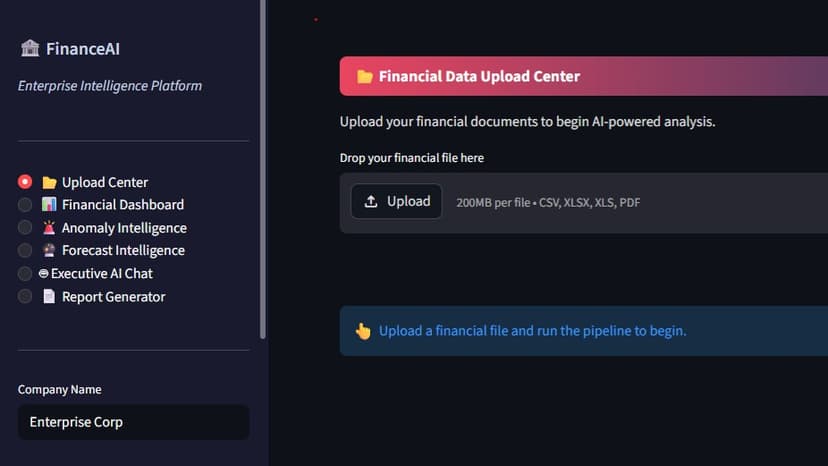
This project is designed for enterprise-grade financial intelligence and analytics. The platform uses multiple AI agents to: Analyze financial datasets Detect suspicious anomalies Forecast financial trends Generate executive insights Provide AI-powered decision support Multi-Agent Architecture The system contains specialized AI agents: 1. Extraction Agent Processes CSV, Excel, and PDF financial documents Cleans and structures financial data 2. Financial Analysis Agent Calculates KPIs Generates financial insights Evaluates business health 3. Anomaly Detection Agent Detects suspicious financial activity Identifies abnormal transactions Performs risk classification 4. Forecasting Agent Predicts future financial trends Generates forecasting intelligence Estimates business risks 5. Executive Intelligence Agent Produces executive summaries Generates strategic recommendations Answers financial questions System Architecture: User Uploads Financial Data ↓ Document Extraction Agent ↓ Semantic Financial Classifier ↓ Financial Analysis Agent ↓ Anomaly Detection Agent ↓ Forecasting Agent ↓ Executive Intelligence Agent ↓ Dashboard + Reports + AI Chat Intelligent Features Semantic Financial Understanding The system intelligently distinguishes between: Financial Columns revenue expenses payments invoices Non-Financial Columns transaction_id age quantity zip_code This prevents invalid analysis and improves enterprise accuracy. Anomaly Detection The platform detects: Fraud indicators Suspicious transactions Expense spikes Abnormal vendor payments Revenue inconsistencies Forecast Intelligence The forecasting system provides: Revenue predictions Cashflow forecasting Financial trend analysis Risk forecasting Executive AI Chat Users can ask: Why did revenue decrease? What is the biggest financial risk? Predict next quarter performance Identify suspicious activities Dataset Intelligence
19 May 2026


