

Tejeshwar A SENTHILKUMAR@Tejeshwar09
1
Events attended
1
Submissions made
India
1 year of experience
About me
I’m Tejeshwar, a first-year B.Tech student specializing in Cyber Security at SRM Institute of Science and Technology, Ramapuram. Technically, my primary area of interest is Cyber Security, especially ethical hacking, network security, OSINT, and security operations. I have hands-on experience with tools such as Nmap, Burp Suite, Wireshark, Metasploit, Gobuster, Hydra, Shodan, Maltego, theHarvester, and Amass. I also practice cybersecurity through platforms like TryHackMe and Hack The Box and have worked on areas including reconnaissance, vulnerability assessment, networking, and basic digital forensics. Alongside cybersecurity, I have a strong interest in software and web development. I work with Python, JavaScript, HTML, CSS, React, SQL, MongoDB, and Node.js, and I’m continuously improving my full-stack development skills. I also have experience with Git, GitHub, Docker, and Linux environments. I’m particularly interested in combining cybersecurity with emerging technologies such as Artificial Intelligence, Blockchain, and Web3. I have worked on projects involving AI agents, blockchain-based applications, cybersecurity tools, and web platforms. I also participated in hackathons where I worked on developing practical solutions under time constraints.
🤝 Top Collaborators




🤓 Latest Submissions
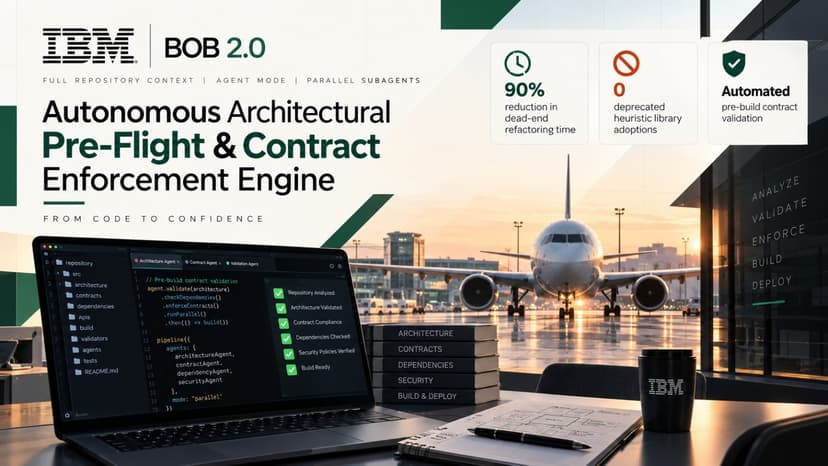
Architectural Pre-Flight
Problem and Challenge Modern AI coding agents and developers generate code faster than teams can manually validate its architectural consequences. This speed often bypasses repository context, resulting in broken service boundaries, duplicate abstractions, renamed fields that break downstream consumers, and deprecated dependencies. These issues are traditionally discovered only after implementation has already created high refactoring costs and technical debt. Solution Architectural Pre-Flight is an AI-assisted engineering governance layer built on IBM Bob 2.0 that sits before implementation. Instead of immediately allowing a coding agent to write code, the system ingests natural-language change requests, maps them against a repository knowledge graph, and runs parallel specialist subagents to evaluate architecture rules, contracts, dependencies, and downstream impact. Target Users Software developers working in large or unfamiliar repositories. Technical leads and architects needing enforceable guardrails. Engineering teams leveraging AI coding agents who want to prevent convention violations. How Users Interact With It Developers submit a natural-language change request via IBM Bob's Plan mode or CLI. The system executes parallel analysis across specialist agents, evaluating policies and contracts. It outputs a clear decision gate: PASS, REVIEW, or BLOCK. If blocked, developers review verifiable evidence, click to generate an AI remediation plan, approve the adjustments, and hand off execution to IBM Bob for compliant implementation and post-flight verification. Creativity and Uniqueness Unlike post-commit linters or traditional static analysis tools, Architectural Pre-Flight acts as an active pre-implementation decision gate. It uniquely combines repository-wide knowledge graphs, architecture-as-code policies, and IBM Bob 2.0's subagent orchestration to answer a fundamental question: Should this change be built at all? Effectiveness and Efficiency By shifting validation left of implementation, the platform targets a dramatic reduction in dead-end refactoring time, enforces zero tolerance for policy-violating dependencies, and achieves automated pre-build contract validation—turning AI coding from generate first, debug later into validate first, build confidently.
27 Sep 2026
