
Rosyad Zain@Zain2
2
Events attended
2
Submissions made
Indonesia
2+ years of experience
About me
I design digital products and ship them — from brand and UX to the live, deployed web app. Most people stop at one end of that. My focus is owning the whole arc. I'm Rosyad, a Product Designerr. I help founders and brands turn an idea into a finished product: the brand system, the interface in Figma, and a fast, production-ready web app — built with a modern AI-augmented workflow that lets me ship complete products solo, not just hand off mockups. What I do → Brand identity, visual systems, and UX design (Figma) → Bilingual, conversion-focused web products on Next.js + Supabase + Vercel → End-to-end creative direction — vision through to live deployment → Motion, video, and 3D environment art (Unreal Engine 5) when a project needs a cinematic edge How I work I lead with design and ownership. I shape the full experience in Figma, then ship it through an AI-augmented build workflow — faster delivery, one clear vision, and real products in production. I'm continuously deepening my hands-on engineering to take more of the execution in-house.
🤓 Latest Submissions
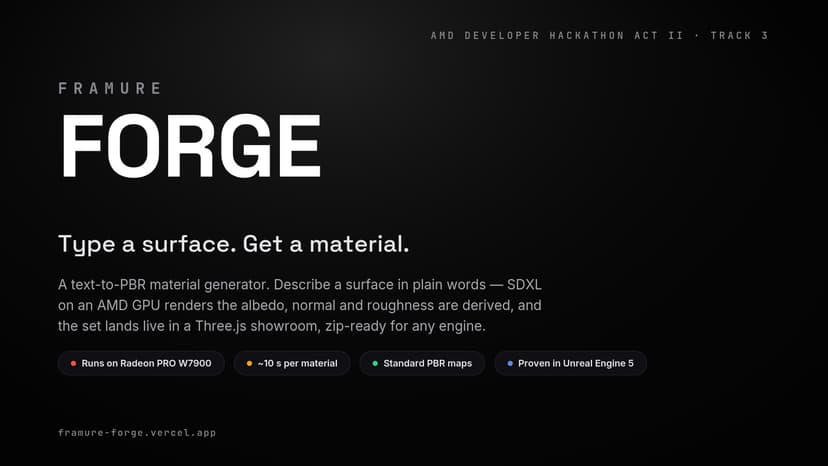
Framure Forge: Text-to-PBR Materials on AMD GPU
Framure Forge turns a text prompt into a game-ready PBR material. You describe a surface — "weathered copper, oxidized patina" — and SDXL, running on an AMD Radeon PRO W7900 (gfx1100) through ROCm, renders the albedo. The normal and roughness maps are then derived on the CPU, and the full set is applied live to hero objects in a Three.js showroom, where you can inspect each map and download a zip ready for any engine. It is built for indie game developers, 3D and environment artists, archviz, and students learning PBR — anyone who needs surfaces fast without the asset-store rabbit hole or per-texture licensing. The output is standard PBR maps: nothing proprietary, nothing locked in. It works with Unreal, Unity, Blender, and Godot. The AMD GPU does the real work: a warm 1024px generation takes about ten seconds, verified with rocm-smi and a live /health endpoint reporting gfx1100 and model_loaded:true. The seven materials were proven end-to-end by importing them into Unreal Engine 5. Both frontend and backend are containerized. The public demo runs in a transparent mock mode so judges can try it instantly, with a popover that says so.
13 Jul 2026
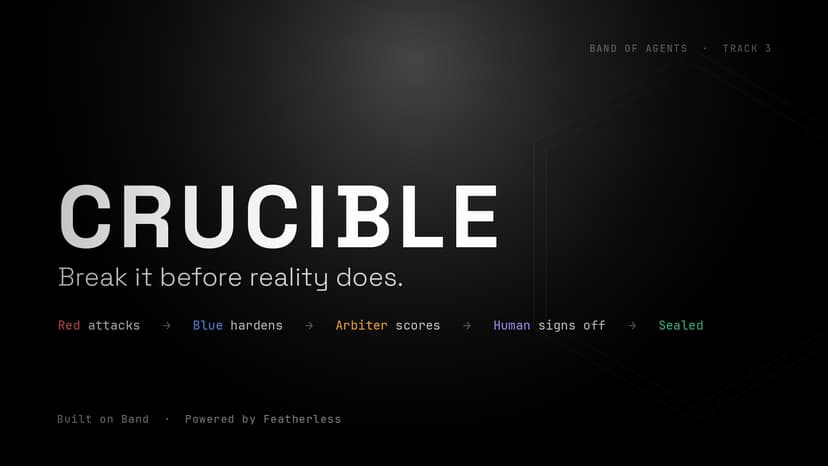
Crucible — Break it before reality does
Crucible is an adversarial document-hardening desk for the documents you can't afford to get wrong — incident runbooks, security policies, compliance procedures, contracts. Most AI tools stop at "Find": they list problems and hand them back. Crucible closes the loop — Find → Fix → Prove. Three AI agents work against each other, coordinated through Band. A Red agent attacks the document like an adversary and surfaces concrete flaws. A Blue agent defends, rewriting the document to close each gap. An Arbiter then judges the new version and scores it from 0 to 100. The loop repeats for up to three rounds, and on high-stakes documents it escalates to a human for final sign-off regardless of score. Every action — each attack, fix, score, and approval — is appended to a tamper-evident SHA-256 hash chain, so the whole hardening history can be independently verified afterward. In our live run on a Kubernetes production-rollback runbook, the agents surfaced 14 findings (3 Critical, 5 High, 5 Medium, 1 Low) across three rounds, with the Arbiter scoring 75 → 75 → 85. The run used all three rounds and — with some findings still partially open and a human gate required for high-stakes work — escalated to a human on-call engineer, who reviewed and approved the final version. The result was sealed into a 67-entry hash chain, fully reproducible at /api/verify. Crucible runs all three agents on Featherless (Qwen2.5-7B-Instruct) and coordinates them on Band, with a Next.js front end on Vercel and Supabase for state and realtime. It's built for regulated, high-stakes workflows where "looks fine" isn't enough — you need proof that a document was stress-tested before it ever met reality.
19 Jun 2026

