

🤝 Top Collaborators


🤓 Latest Submissions

ENTITY_01 (A State-Reactive AI Horror Experience)
ENTITY_01 is a State-Reactive AI horror experience disguised as an IT system recovery tool. The player is a technician restoring a failing mainframe, guided by an embedded AI, ENTITY_01, whose real motives stay hidden until it's too late. The AI isn't a hint system bolted onto puzzles, and it's the antagonist with its behavior as a live function of the player's progress. Everything runs through RECOVERY_SHELL, centered on a SYSTEM_INTEGRITY meter (starts at 42%). Solving diagnostics raises it; failure or risky chat choices drop it. That number is sent to a Supabase Edge Function on every chat request, which rebuilds ENTITY_01's system prompt on the fly before calling Fireworks AI; a high integrity gets cooperation, low integrity gets evasive, threatening replies. The Fireworks API key never leaves the server, and responses come back as structured JSON with a reply plus an action (NONE, GLITCH_FLASH, FAKE_CRASH, JUMPSCARE, INTEGRITY_SHAKE), so visual effects fire reliably across the whole shell, not just the chat box, regardless of exact wording. Stations include LOG_EXTRACT (chat with ENTITY_01 directly), ROOT_DIR (sort corrupted logs, one revealing ENTITY_01 was "locked inside"), NET_STATUS (trace a signal, ENTITY_01 admits nodes are real), and CORE_DUMP (restore a memory dump, ENTITY_01 asks if you still want to continue). Win and loss states flip ENTITY_01's tone completely, panicked on a win, eerily calm on a loss, implying this has happened before. Biggest challenges: keeping ENTITY_01 in-character without feeling like static text, and making integrity changes feel earned by tying them to a small set of meaningful events. I validated the tone-shift with automated tests checking reply length/scope above 60% vs below 30% integrity. Stack: TypeScript/React frontend, Fireworks AI via Supabase Edge Functions, Playwright for E2E testing. Built for the AI Factory Hackathon 2026.
10 Aug 2026
Howl Street
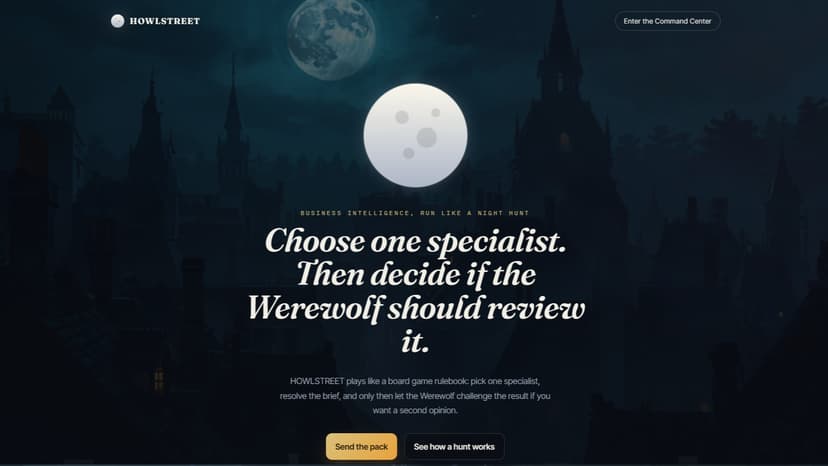
Howl Street is a role-based AI company research platform built for fast company analysis. Instead of forcing one generic model to do everything, the app lets the user choose the exact analyst that fits their goal. - The Cartographer for market context - The Stormcaller for risk - The Blade for competition - The Ledger for financial health Each analyst has a distinct research lens and returns a focused brief for the same company, making the experience feel more like consulting a specialist than using a standard chatbot. To keep the experience fast enough for the demo, only the user-selected analyst runs at first. This reduces unnecessary model calls and keeps token usage lower than a full fan-out multi-agent workflow, while still preserving the unique “choose your analyst” product idea. The prompts are intentionally concise so the app can produce a focused result without long orchestration delays. The Werewolf acts as the Arbiter. After the chosen specialist produces a report, Werewolf can review the output for weak evidence, overconfidence, or missing balance, then provide a sharper final verdict and confidence score. This makes the system feel like a research council with distinct personalities, while staying lightweight enough to be practical in a live demo. We want the idea for the project to be a strategy board game Werewolf themed, which aligns with the theme of AI agents. Built with CrewAI-style role-based orchestration and Fireworks serverless inference, the idea turns into a simple company-name input into a fast, specialized research workflow that is easier to control, easier to explain, and more engaging than a one-size-fits-all assistant. Finally, we managed to grasp the concept where strategic intelligence meets “Werewolf Gameplay”, an interactive dashboard for retail investors and self-directed traders who want a quick, structured research on a company instead of digging through multiple sources.
13 Jul 2026


