
🤓 Latest Submissions
OnRecord - verificarion for spoken claims
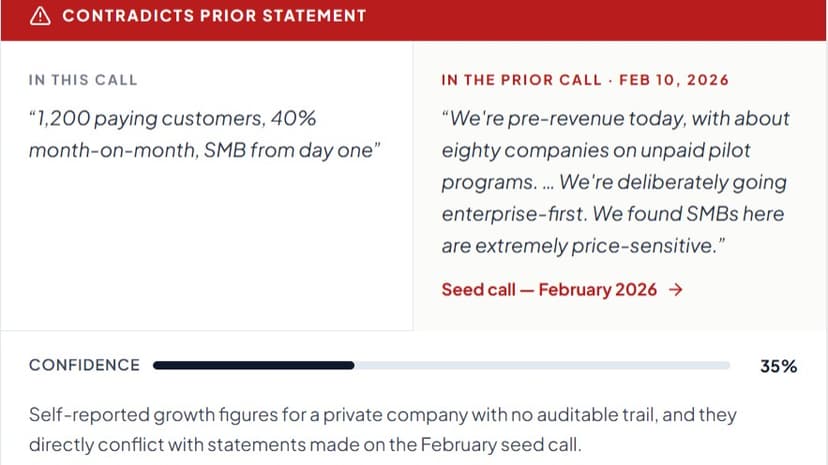
Problem statement: In founder pitches, vendor demos, and partner calls, people make confident, specific, checkable claims — market sizes, competitor pricing, "we're the only ones who do X." Almost none of it is verified before a decision is made. Verification is manual and slow: listen back, work out which claims are checkable, open twenty tabs, then try to remember whether this person said something different eight months ago. The evidence is public. The bottleneck is that nobody can traverse it fast enough. Target user: Analysts, angel investors, and operators evaluating founder pitches, vendor demos, and partner calls. Adjacent: journalists and podcast producers doing pre-publication verification, enterprise vendor diligence, and comms teams reviewing their own executives. How native.builder was used: Built end to end in native.builder. Product Architect scoped the PRD, data model, and Edge Function architecture before any code was written — it surfaced four design problems in my brief, including an ambiguity about which Bright Data product the pipeline needed. Task Planner produced the dependency graph. Builder agent generated the React application, Supabase schema, and Edge Functions across ten incremental prompts, and diagnosed a stale Vite dependency cache without intervention. The UI, data model, verdict logic, and contradiction detection are complete and demonstrated on fixture data. The Speechmatics transcription Edge Function is built and deployed; the multipart submission format is still being resolved. Tools: native.builder, Supabase (Postgres, Storage, Edge Functions, Realtime), Speechmatics Batch API, Bright Data (SERP API, Web Unlocker), AI/ML API, React, Vite, Tailwind.
10 Aug 2026
NourAI : Your AI Recovery Companion
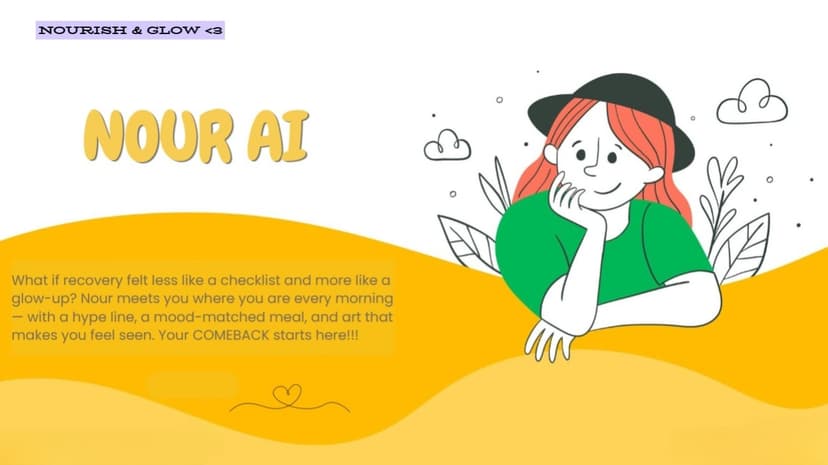
Eating disorders affect over 70 million people globally, yet most digital recovery tools are either clinically sterile or dangerously naive about the psychological complexity of recovery. Nourish bridges that gap. Nourish is a multi-agent AI system that meets you exactly where you are emotionally — every single morning. It reads your mood, then delivers a personalized Daily Card: a warm hype line written just for you, a mood-matched meal suggestion that respects your safe and trigger food boundaries, a curated color palette and real museum artwork chosen to help you feel grounded and seen, and a heartfelt progress note from your AI recovery pal, Nour. What makes Nourish genuinely different is the combination of art therapy and eating disorder recovery in one system. Research consistently shows that engagement with art and aesthetics supports emotional regulation, identity formation, and body neutrality — all critical pillars of ED recovery. Nourish gives patients something beautiful to look forward to every morning — not a symptom tracker, not a calorie log, but a moment of color, warmth, and encouragement that says: you are more than your disorder. The system never mentions calories, weights, or body appearance. Food is framed around taste, warmth, color, and curiosity. Nour — the AI companion — validates your emotional struggles without judgment, celebrates every small act of courage, and stays with you across a 30, 60, or 90 day recovery arc. Built on AMD GPU using Qwen 2.5-7B and FLUX.1-schnell, Nourish runs entirely on open-source models — making it accessible, private, and scalable.
10 May 2026


