
🤝 Top Collaborators



🤓 Latest Submissions
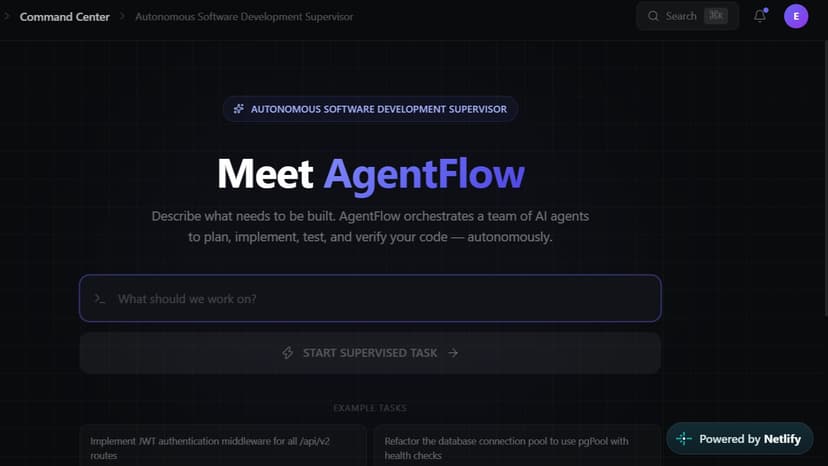
AgentFlow
The problem AI coding assistants are fast, but they don't verify their own work. They generate plausible-looking changes without running the test suite, tracing a real failure, or confirming a fix actually works. Developers are left babysitting every AI-authored change — manually re-running tests, tracing root causes by hand, and treating “done” as a claim rather than a fact. This verification gap is exactly where trust in AI-assisted development breaks down, and it burns the hours the AI was supposed to save. The solution AgentFlow flips the model: instead of one assistant that writes code and hopes it works, a Supervisor coordinates three specialist agents — Code Intelligence, Test & QA, and Debug & Review — through a closed verification loop. A developer submits one sentence describing the change they want. Code Intelligence maps the impact and risk; Test & QA runs the real suite against a baseline; the change is implemented and retested. If anything fails, it never dead-ends — Debug & Review traces the root cause, reapplies a fix, and the suite runs again, automatically, until the change is actually correct. Every step — every test run, every failure, every fix — is written to an Evidence Ledger, a chronological, audit-ready log that backs each checklist item with real data pulled from the task itself, not a mock or a summary. Only once that evidence exists does AgentFlow ask a human for approval: one click to merge, or reject, backed by proof instead of a promise. Who it's for AgentFlow is built for development teams who already use AI coding assistants and are tired of the babysitting tax — the hours spent re-verifying changes an assistant claimed were “done.” A developer interacts with it through a single dark-themed console: they describe a change, watch the Supervisor route it through the three agents in real time, and see a live, evidence-backed checklist before they ever touch the code themselves. Why it's different Most AI dev tools stop at code generation. AgentFlow's differentiator is the evidence-driven recovery loop: failures are treated as an expected part of the process, not a dead end — the system retries and re-verifies on its own, and the only thing a human ever approves is a change that has already been proven, not just proposed. In our integrated build, this loop coordinated 3 specialized agents across 5 live frontend pages and 218 backend tests, with 100% of approvals backed by logged evidence rather than an unverified claim.
27 Sep 2026
