🤝 Top Collaborators

🤓 Latest Submissions
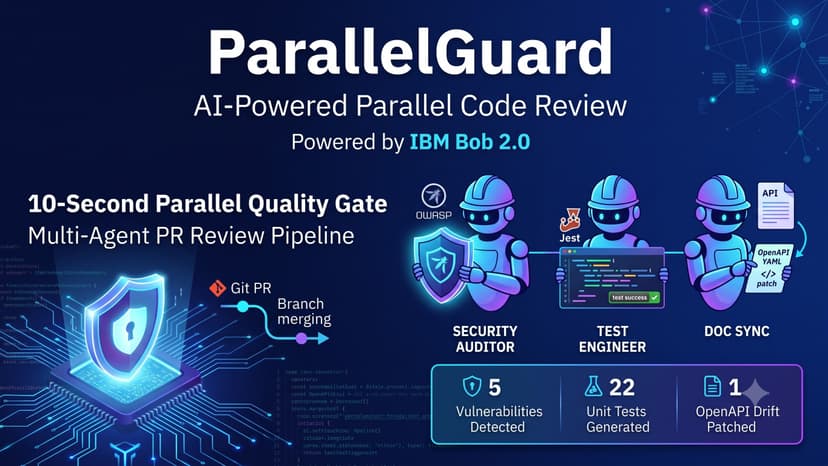
ParallelGuard-AIPowered Code Review Infrastructure
Problem Statement: Manual pull request (PR) reviews represent one of the most expensive and error-prone bottlenecks in modern enterprise software delivery. Engineering teams typically spend between 4 to 6 hours per PR navigating manual QA checks, back-and-forth review comments, and compliance verification. Despite this significant time investment, human reviewers frequently miss subtle yet catastrophic flaws—such as hardcoded JWT secrets, missing input null-guards, and OWASP Top 10 vulnerabilities—allowing high-risk security bugs to slip into production environments. Compounding this issue is the widespread challenge of documentation and test drift. In fast-paced deployment cycles, developers routinely update backend code without simultaneously updating public OpenAPI/Swagger specifications or expanding unit test suites. As a result, API documentation quickly becomes obsolete, breaking downstream integrations, while test coverage fails to account for critical edge cases and boundary conditions. Existing developer tools attempt to solve these problems in isolated, single-purpose silos, forcing pipelines through sluggish, sequential review stages that frustrate developers and delay release schedules. Detailed Solution Overview: ParallelGuard transforms this fragmented, high-friction workflow into an automated, single-pass quality gate powered by IBM Bob 2.0. By leveraging IBM Bob’s advanced document understanding and parallel subagent orchestration, ParallelGuard automatically ingests repository guidelines and executes three domain-specific AI subagents concurrently within isolated context windows: 1.Security Auditor (Subagent A): Performs real-time static analysis on incoming code diffs to flag exposed credentials, unpinned cryptographic algorithms, and injection vectors. It assigns formal CVSS-aligned severity scores (CRITICAL to LOW) alongside precise file locations, line numbers, and copy-paste remediation snippets. 2.Test Engineer (Subagent B): Analyzes modified function Abstract Syntax Trees (ASTs) to automatically write comprehensive unit tests using frameworks like Jest or PyTest. It targets unhandled null/undefined inputs, boundary conditions, and security bypass edge cases (e.g., rejecting tokens signed with the 'none' algorithm). 3.Doc Sync (Subagent C): Cross-references modified route handlers directly against openapi.yaml and repository documentation. It detects missing or altered API endpoints and drafts ready-to-merge, syntactically valid YAML patches to guarantee 100% documentation parity. Key Innovation & Business Value: Rather than executing security scans, test generation, and documentation checks in a slow linear sequence, ParallelGuard executes all three workflows simultaneously in under 10 seconds. The pipeline consolidates all subagent reasoning, findings, and test suites into a single, structured audit_report.json artifact posted directly as an interactive PR comment. 1.>50% Reduction in Review Cycles: Accelerates time-to-market by cutting PR wait times from hours down to minutes. 2.Zero Credentials in Production: Provides 100% deterministic detection of hardcoded secrets before code ever merges to main. 3.Automated Compliance Tracking: Generates audit-ready JSON reports to streamline enterprise governance, security logging, and CI/CD integration
27 Sep 2026

