
🤓 Latest Submissions
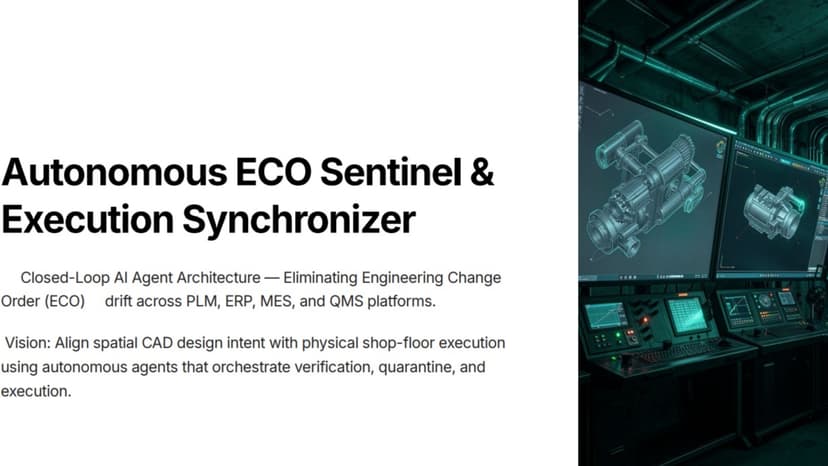
Autonomous ECO Sentinel and Execution Synchronizer
. Autonomous ECO Sentinel & Execution Synchronizer Executive Summary In complex discrete manufacturing—such as aerospace, defense, industrial machinery, and high-tech electronics—approving an Engineering Change Order (ECO) in a Product Lifecycle Management (PLM) system represents design intent, not physical execution on the factory floor. Due to structural mismatches between spatial Engineering Bills of Materials (EBOMs) and chronological Manufacturing Bills of Materials (MBOMs), engineering changes routinely fail to propagate downstream. This disconnect creates Engineering Change Drift: technicians continue using superseded drawings, procurement orders obsolete components, and factories experience catastrophic rework and assembly line stoppages. The Autonomous ECO Sentinel & Execution Synchronizer acts as an enterprise orchestrator, bridging PLM design releases directly with ERP inventory quarantines, MES standard operating procedures (SOPs), QMS quality inspection gates, and SCM supplier portals.
18 Oct 2026

GPU Cost Leak Simulator
Small AI engineering teams almost never have the headcount, budget, or bandwidth to run a dedicated FinOps operation, nor do they want the massive operational overhead of managing complex Kubernetes clusters just to track compute utilization. Infrastructure management usually falls on the developers themselves, who are far more focused on training models, optimizing pipelines, and shipping features than digging through convoluted cloud bills or setting up custom telemetry stack dashboards. This is precisely where the AI Leak Simulator changes the game. It strips away all the unnecessary operational friction by eliminating the need for agent installations, cluster-level metrics scraping, or dedicated financial engineering workflows. Instead, it operates on a lean, input-driven model: you simply provide your total GPU fleet size, the specific GPU types in your stack (e.g., NVIDIA H100s, A100s, or L40S instances), and your estimated or measured total idle GPU capacity.
16 Sep 2026


