

🤓 Latest Submissions
VoiceVLA
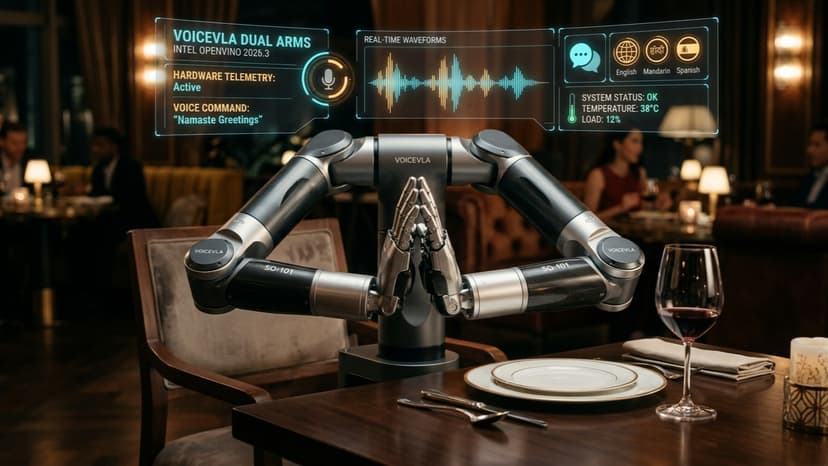
VoiceVLA directly addresses Intel's challenge brief, "Bimanual VLA Manipulation with Multi-Modal Reasoning — setting up a dinner table," by fusing physical motor control, multilingual speech understanding, and edge-based visual perception into a single embodied intelligence architecture. Key Pillars High-Fidelity Physics (MuJoCo): Setting a dining table demands precise spatial reasoning, synchronized dual-arm trajectory planning, and delicate force management to handle fragile glassware and cutlery. VoiceVLA utilizes the MuJoCo physics engine to simulate realistic contact dynamics and joint constraints, ensuring fluid, collision-free bimanual execution. Real-Time Voice Intelligence (Speechmatics): Human-robot interaction is powered by Speechmatics, supporting real-time voice processing across the top 10 world languages—explicitly including natural Hinglish code-switching (fluidly blending Hindi and English). Users can issue flexible, conversational spoken commands during task execution without adhering to rigid syntaxes. Edge Quality Inspection (Anomalib v2.6.0 + Intel OpenVINO 2026.3): Before placing dining items, VoiceVLA performs real-time visual defect detection using an anomaly pipeline powered by Anomalib v2.6.0 and accelerated with Intel OpenVINO 2026.3. This identifies surface defects, hairline cracks, or smudges directly on local edge hardware without cloud latency penalties. By combining physics-driven bimanual simulation, broad multilingual voice interaction, and local computer vision, VoiceVLA delivers a production-ready solution for Intel's multi-modal manipulation benchmark.
16 Sep 2026
GKJ_Coder - One-Terminal MCP Orchestra
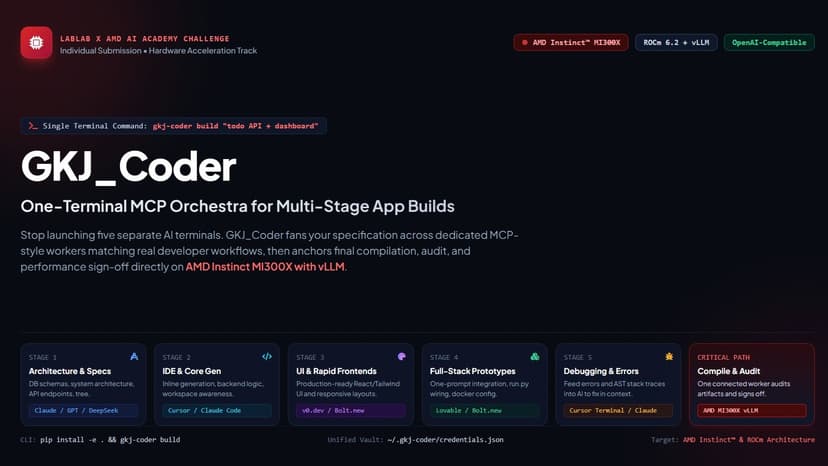
The Core Problem Juggling multiple AI CLI terminals to build complex software creates high operational friction. Copy-pasting code between isolated sessions for backend logic, DB migrations, unit testing, and security scans leads to context drift, broken interface contracts, and high manual integration overhead. Autonomous Spec Fan-Out via MCP Workers GKJ_Coder replaces disjointed terminal sessions with a unified orchestration engine. A single feature specification is automatically parsed and fanned out across specialized, Model Context Protocol (MCP) compliant workers running in parallel: Architecture: Establishes module boundaries and strict API schemas. Core Logic: Generates backend logic and functional application modules. Data Layer: Constructs database schemas, ORM mappings, and migrations. Quality Assurance: Generates unit, integration, and boundary test suites. Security Audit: Scans code paths in real time for vulnerabilities. Operating on a shared MCP state graph, these workers cross-validate interfaces, resolve dependencies, and fix breaking changes autonomously before delivery. Hardware-Accelerated Compilation & Sign-Off GKJ_Coder anchors final whole-repository compilation, deep static auditing, and performance sign-off directly on AMD Instinct MI300X accelerators using vLLM: 192GB HBM3 Memory: Loads complete repository context trees simultaneously, eliminating token truncation and lost attention. vLLM Engine: Utilizes PagedAttention and continuous batching for ultra-fast multi-agent reasoning, type checking, and dependency resolution. Automated Sign-Off: Executes multi-file compilation, security scans, and latency benchmarking before delivering code to developers. Summary Impact Replaces 5+ disconnected terminal windows with a single input. Eliminates context drift via dynamic state synchronization. Delivers verified, compiled, and benchmarked code ready for production review.
1 Dec 2026


