
🤓 Latest Submissions
ShiftWhy — Industrial Maintenance Intelligence
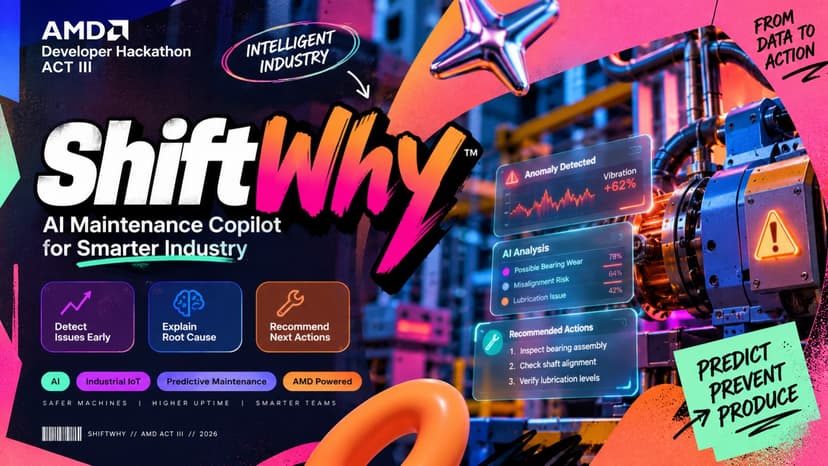
ShiftWhy is an AI-assisted industrial maintenance copilot designed to help factory teams investigate equipment anomalies, understand potential failure causes, and make better-informed maintenance decisions before minor issues become costly downtime. The application combines synthetic machine telemetry, maintenance history, anomaly indicators, and operator-reported symptoms to create an evidence-backed investigation. Instead of returning a generic chatbot response, ShiftWhy presents relevant observations, possible causes, supporting evidence, risk indicators, and technician-reviewed next checks. Its goal is to help maintenance teams move from fragmented machine data to a structured and explainable first assessment. The system includes an interactive industrial dashboard, machine fleet monitoring, investigation workflows, maintenance recommendations, and a configurable AMD-hosted AI integration through AMD Token Factory. The AI layer is intended to interpret the available evidence and generate contextual explanations, while the application's investigation logic helps organize the findings into a readable workflow. ShiftWhy is designed with human oversight in mind. Its recommendations are intended to support qualified technicians, not replace safety procedures, engineering judgment, or approved maintenance protocols. The current prototype uses synthetic factory data to demonstrate the workflow; its results are illustrative and are not claims of validated industrial performance or measured downtime reduction. By combining AI-assisted reasoning, operational context, and explainable maintenance workflows, ShiftWhy explores how AMD-powered AI can help industrial teams investigate equipment issues more efficiently and build a foundation for predictive maintenance.
18 Oct 2026

EdgeGate — Evidence-Gated Physical AI
EdgeGate is an evidence-gated runtime authorization layer for Physical AI. It addresses a critical deployment problem: perception systems can produce stale, drifting, obstructed, or unsafe observations while downstream AI systems may still attempt to act on them. EdgeGate places a deterministic authorization layer between perception and physical action. Every proposed action is evaluated against runtime evidence including perception confidence, scene freshness, spatial clearance, environmental drift, and restricted-zone constraints. The system produces an explicit runtime decision: PROMOTE, ROLLBACK, or REJECT. Instead of treating model output as automatically executable, EdgeGate requires the proposal to satisfy safety gates before authorization. The prototype includes replayable safety scenarios demonstrating how the same policy responds to fresh perception, stale state, drift, and restricted-zone violations. Each decision generates an evidence ledger containing the observed telemetry, gate results, reasons, and final authorization decision. OpenVINO provides the local CPU edge inference path, while the policy engine remains deterministic and auditable. This architecture is designed for low-latency edge deployment where connectivity, explainability, and predictable failure behavior matter. EdgeGate is a hackathon prototype using synthetic scene telemetry for deterministic policy demonstration. It does not directly control a physical robot and is not a safety certification.
16 Sep 2026


