
🤝 Top Collaborators



🤓 Latest Submissions
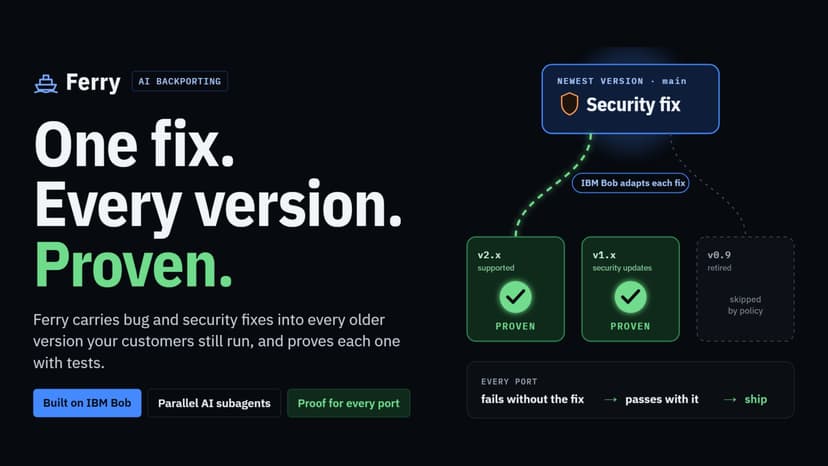
Ferry: Every Fix, Every Release, Proven
THE PROBLEM When a bug or security fix lands on the main branch, customers running older supported versions need it too. Getting it there is called backporting, and it is still mostly manual. Existing backport bots only handle the easy case: if the fix applies cleanly, they open a pull request. But on long-lived release branches, code moves, functions get renamed and signatures change, so the fix no longer applies. A developer then has to resolve it by hand. Fixes reach older releases late or never, and customers stay exposed after the fix has shipped. THE SOLUTION Ferry carries every fix into every supported release branch and proves each port with tests. It runs in six steps: 1. Audit: finds fixes on main that never reached a release branch. 2. Scope: IBM Bob reads the support policy (PDF) and security advisory (DOCX) and decides, for each branch, whether to port, skip or mark it not applicable, citing the exact section behind each decision. 3. Try: a plain cherry-pick. Clean ports finish instantly at zero AI cost. 4. Adapt: every conflicted port gets its own IBM Bob subagent, all running in parallel. Each one traces renamed and moved code through git history, adapts the fix to that branch, and ports the regression test. 5. Verify: every regression test must fail before the fix and pass after it, and the branch's full test suite must stay green. 6. Report: a dashboard shows the release matrix, the reason and proof behind every cell, side-by-side diffs and per-branch changelogs. WHO IT IS FOR Maintainers and release managers of any software that supports more than one version: enterprise products, libraries, LTS releases and security teams. They run Ferry after a fix merges, then review one dashboard instead of resolving each conflict by hand. WHAT MAKES IT UNIQUE - It handles the conflicted ports that existing bots hand back to humans. - It proves every port per test, not just "the build passed". - Every decision is traceable to the policy document that justifies it. - Built-in guardrails route judgment calls to a human, such as a fix that changes tested behaviour on a maintenance branch. RESULTS ON THE DEMO PROJECT (a library with four diverged release lines) - The audit found 2 security fixes missing from every supported release branch. - All 12 port/skip decisions were made from the documents, each with a citation. - 4 of 4 ports proven: 1 clean cherry-pick at 0 Bobcoins, plus 3 conflicted ports adapted in parallel by Bob subagents. - One conflicted backport took 16.4 minutes by hand. Ferry adapted and proved three in [X] minutes, at about 1.4 Bobcoins per port. IMPACT Faster, proven backports shrink the window in which customers on older releases stay exposed, remove repetitive conflict resolution from developers' days, and give auditors a clear record of what shipped where, and why.
27 Sep 2026
EventifAI
Our application is a comprehensive event scheduling and management solution that leverages the power of AI to enhance efficiency and personalization. It seamlessly integrates with Google Calendar to automate event scheduling, taking into account location details for smart scheduling. Participants are effortlessly added, and personalized invitations are sent out, including meeting links for online events. Depending on the tone of the email (formal or informal), our AI generates customized templates to ensure appropriate communication. For onsite events, the application provides Google Map services for precise navigation and travel time estimation. Additionally, a specialized Llama 3 chatbot offers 24/7 support, answering queries and assisting with scheduling tasks. This AI-powered assistant ensures users have access to help at any time, enhancing the overall user experience. Our application is the ultimate tool for organizing any event, offering a seamless and user-friendly experience that caters to all scheduling and management needs, from detailed event information to efficient communication and reliable navigation.
2 Jul 2024


