
🤝 Top Collaborators




🤓 Latest Submissions
CodeAuditor AI
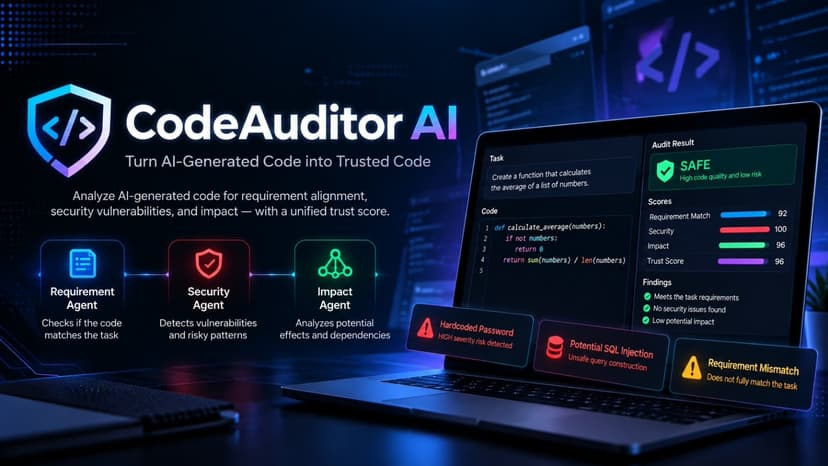
AI coding assistants and agentic development tools can generate working code very quickly, but generated code is not always code that developers should trust. It may fail to fully satisfy the original requirement, introduce security vulnerabilities, or create unexpected impact on existing code. Manually reviewing every AI-generated change increases development effort and can allow important issues to be missed. CodeAuditor AI addresses this problem by acting as an automated auditing layer between AI-generated code and the developer. A developer provides the original task or requirement and the generated code. The system analyzes the code using three specialized agents. The Requirement Agent checks whether the implementation actually matches the requested functionality and identifies requirement gaps. The Security Agent looks for common security risks such as hardcoded credentials, unsafe input handling, SQL injection patterns, and other risky coding practices. The Impact Agent evaluates potential effects on callers, dependencies, tests, documentation, and surrounding code. A Coordinator combines the results from these agents into a unified audit report containing a trust score, overall verdict, requirement match, security assessment, impact level, findings, and recommendations. The target users are developers, development teams, and organizations using AI coding assistants. Instead of blindly accepting AI-generated code, users can quickly inspect its risks before integrating or deploying it. The project is implemented with a React/Vite frontend and Python Flask backend using a multi-agent architecture. The application is deployed as a working web application and can analyze real code through the complete frontend-to-backend pipeline. The key idea is simple: AI can generate code quickly, but CodeAuditor AI provides an additional validation layer to help developers decide whether that generated code deserves to be trusted.
27 Sep 2026
