
🤓 Latest Submissions
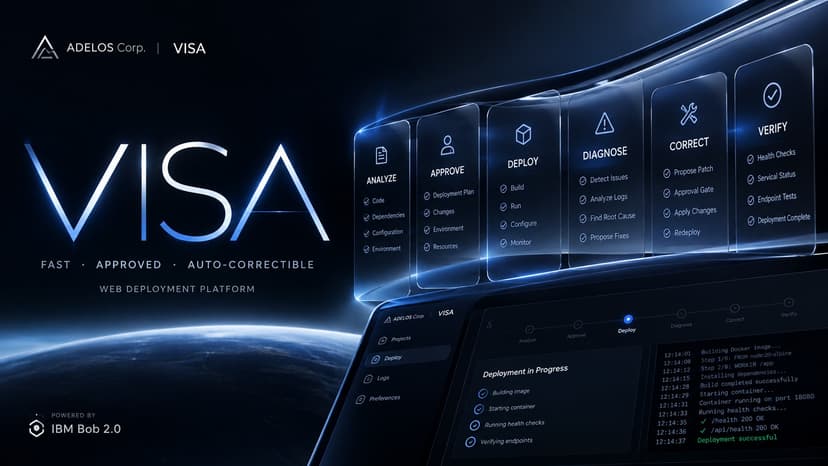
VISA.
Modern web deployment can become a fragmented and time-consuming process. Developers must inspect source code, dependencies, configuration, runtime requirements, and deployment settings before shipping an application. When deployment fails, they often need to manually inspect logs, identify the root cause, modify configuration, redeploy, and verify the result. This creates unnecessary delays and increases the chance of human error, especially for developers managing multiple applications. VISA (Fast · Approved · Auto-Correctible Web Deployment Platform) addresses this problem by creating a controlled deployment loop that connects analysis, approval, deployment, failure recovery, and verification in one workflow. VISA is designed for developers, students, engineering teams, and anyone who needs to deploy web applications without managing every deployment step manually. A user provides a Git repository or local project. VISA analyzes the project, checking dependencies, configuration, runtime requirements, and deployment conditions. It then generates a deployment plan and presents it to the user for explicit approval before consequential actions occur. After approval, VISA deploys the application using a controlled Docker-based environment and monitors the deployment. It does not treat a successful deployment command as the end of the process. VISA verifies the running application through health checks and deployment telemetry. If a recoverable failure occurs, the system analyzes the failure, identifies a bounded correction, presents the proposed change for approval, applies the approved correction, redeploys, and verifies the result again. What makes VISA distinctive is its closed-loop recovery model. Instead of treating deployment failure as a dead end, VISA makes recovery part of the deployment workflow: Analyze → Approve → Deploy → Detect → Diagnose → Correct → Redeploy → Verify Human approval remains central to the process. VISA is designed to automate repetitive technical work while keeping consequential decisions visible and controlled. The platform combines a Next.js interface, Node.js/Fastify backend, Docker-based deployment, persistent deployment records, live telemetry, and an IBM Bob 2.0 agent architecture for intelligent analysis and recovery workflows. Its interface is designed to make complex deployment activity understandable through clear stages, deployment plans, logs, approval gates, and verification results. By bringing preparation, controlled execution, failure recovery, and verification into a single workflow, VISA aims to reduce manual intervention and make web deployment faster, more transparent, and more reliable while keeping the developer in control.
27 Sep 2026
