
🤓 Latest Submissions

FlashBob
The Problem AI coding agents running inside editors like IBM Bob or VS Code operate with a finite context window — typically 100K to 270K tokens, meaningful effective context is even lesser. When an agent is given a task in a large codebase, it must decide which files to read before it can act. The naive approach — loading all files — saturates the context and leaves little room for reasoning, generation, and tool execution. The careful approach — having the agent itself scan and triage files — burns tokens on classification work before the real task even begins. Either way, the agent's most valuable resource is spent on a selection problem, not the problem it was hired to solve. There is no clean separation today between "figure out what's relevant" and "do the work." Both jobs fall on the same model, in the same context window, at the same time. The Solution: FlashBob FlashBob is a cloud workspace mirror with an embedded MCP server and a Jev-powered context selection layer. When a developer opens a folder in IBM Bob, a lightweight sync script (or extension) pushes a full file snapshot to the FlashBob web app over a single HTTP POST. From that point on, every file save streams a delta patch — keeping the cloud mirror in persistent, live sync with the local editor state. The mirror is exposed over two surfaces. First, a clean web UI lets developers browse the synced workspace, inspect any file, and interactively run Jev relevance checks against it. Second, and more importantly, an MCP server runs as a streamable HTTP endpoint at /mcp — directly inside the React Router app, no separate process required. IBM Bob agents connect to this URL in their MCP configuration with a single line. When the agent receives a task, instead of loading files itself it calls get_relevant_files(workspaceId, task) on the FlashBob MCP server. That tool calls Jev — TypeSafe's System One decision model accessed via OpenRouter (typesafe/jev-1.13) — which evaluates every file in the mirror against the task description using two typed questions: a noul (yes/no probability) for relevance and a score (0–2 scale) for importance. Jev returns structured probabilities, not generated text, making it fast and cheap. FlashBob filters and ranks the results, returning only the files that matter. The agent's context window receives a ranked shortlist, not a full codebase dump. Target Users Developers using IBM Bob or VS Code who work on non-trivial codebases and regularly delegate implementation tasks to AI agents. What Makes It Unique The separation of concerns is the key insight: context selection happens outside the agent's context window, in a dedicated classification layer (Jev), while context execution stays clean inside Bob. The cloud mirror provides persistent, always-fresh state that any number of agent sessions can query without re-reading the disk. The MCP interface means zero changes to how developers prompt their agents — they just get better results.
27 Sep 2026
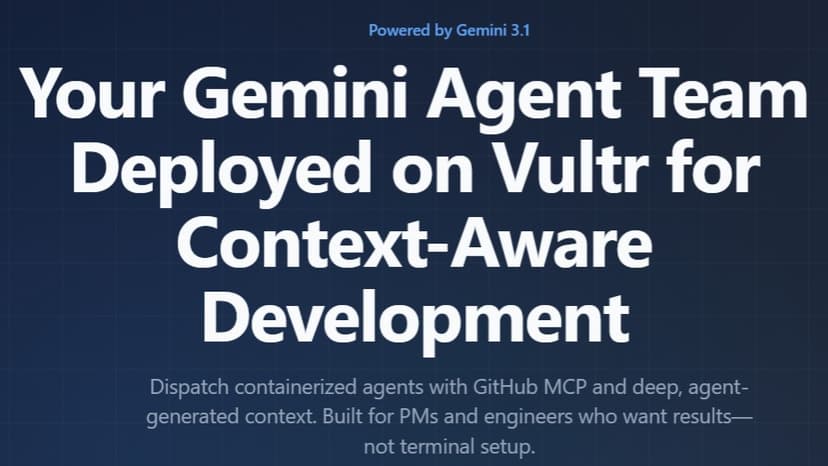
GemCloud
Gemini-powered Gemcloud is a cloud-native development platform built around a collaborative team of four specialized AI agents, each running Gemini 3.1 Pro inside isolated containerized environments. Instead of relying on a single general-purpose coding agent, Gemcloud distributes software engineering responsibilities across dedicated roles to create a more structured and scalable development workflow. The platform’s Designer agent focuses on architecture planning, system structure, and technical decision-making, helping translate high-level ideas into clear engineering direction. The Implementor agent is responsible for feature development and code execution, transforming specifications into working implementations within the repository. The Reviewer agent continuously evaluates code quality, validates implementation correctness, and ensures maintainability through automated review workflows. Meanwhile, the Debugger agent specializes in identifying issues, tracing failures, and resolving bugs across the codebase. Each agent operates independently inside its own Docker container with full Gemini CLI integration, enabling parallel execution while maintaining isolated and reproducible environments. Through the Model Context Protocol (MCP), agents connect directly to GitHub repositories, pull requests, commits, and issues, giving them native awareness of the project lifecycle and engineering workflow. Gemcloud also enables agents to autonomously browse repositories and generate deep, browsable project documentation, ensuring every agent begins with strong contextual understanding rather than spending tokens repeatedly interpreting the codebase. This context-aware, spec-driven workflow allows teams to move from technical specifications to implemented, reviewed, and debugged code entirely in the cloud—without requiring any local setup.
19 May 2026

Codini
Codini dispatches containerized Gemini CLI agents powered by Gemini 3.1 with GitHub MCP and deep, agent-generated context. Built for PMs and engineers who want results—not terminal setup. Codini is a cloud-native platform that spins up an agent swarm of containerized Gemini CLI instances, each running the Gemini 3.1 model. Agents connect to your GitHub repositories via the Model Context Protocol (MCP), browse and document your codebase, and execute spec-driven tasks—all without any local setup. - **🤖 Gemini 3.1 Agent Swarm**: Four specialized agents, each running Gemini 3.1 in isolated containers - **Designer**: Architecture and system design - **Implementor**: Code implementation and feature development - **Reviewer**: Code review and quality assurance - **Debugger**: Issue identification and debugging - **📚 Agent-Generated Deep Context**: Gemini CLI agents browse your repository and produce intelligent, browsable documentation automatically - **☁️ Containerized Cloud Execution**: Each agent runs in its own Docker container with full Gemini CLI integration - **🔗 GitHub MCP**: Model Context Protocol gives agents native access to repos, PRs, issues, and commits - **🔄 Spec-Driven Development**: Transform specifications into working code - **🎯 Context-Aware**: Agents start with full project understanding—no wasted tokens on codebase comprehension
19 May 2026

Bobdock
Bobdock is a cloud-native platform that enables developers to command, dispatch, and manage Bob agents in the cloud. It provides a seamless interface for AI-powered software development through specialized agents that handle different aspects of the development lifecycle. Key Features 🤖 Specialized AI Agents: Four distinct agents for different development tasks Designer: Architecture and system design Implementor: Code implementation and feature development Reviewer: Code review and quality assurance Debugger: Issue identification and debugging 📚 Intelligent Documentation: Automatic generation of project documentation from your repository ☁️ Cloud-Native: Run Bob agents in containerized cloud environments 🔄 Spec-Driven Development: Transform specifications into working code 🎯 Context-Aware: Agents understand your project structure and codebase
17 May 2026


