
🤓 Latest Submissions
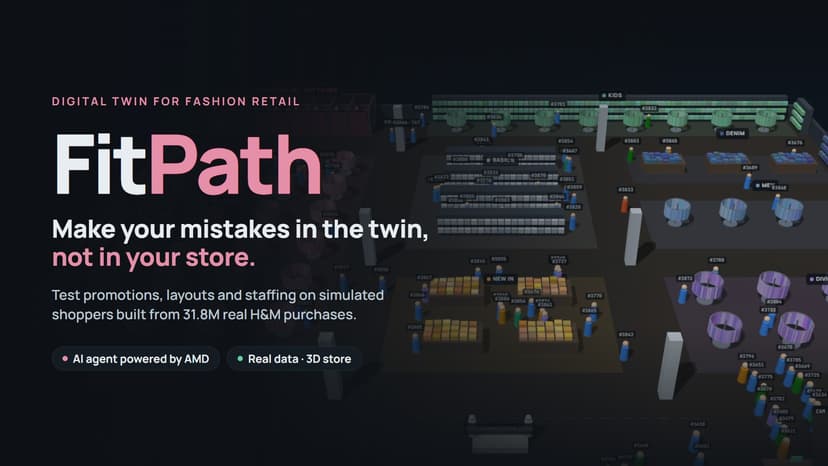
FitPath: The Digital Twin of Your Store
A store cannot be A/B tested. Fast-fashion managers choose promotions, department layouts and staffing on gut feeling, and a mistake only shows up at the end of the season, in lost sales and in shoppers who walk out of the queue. On Black Friday 2019, our twin counted 442 shoppers who gave up at the tills, leaving €10,937 of clothes behind. FitPath is the digital twin of a 2,000 m² fast-fashion store, built on real data: 31.8 million H&M purchases over two years and 7 shopper profiles found by clustering real customers. Each simulated day replays the real receipts of that day. Every shopper walks in, browses, tries clothes on in the fitting rooms and queues at the tills, in a live 3D store you can watch and follow camera by camera. You simply ask the agent, which runs on AMD, a question in plain English, like "would one more till have helped on Black Friday?" It reads the data, turns the idea into a concrete strategy, runs it in the twin against the baseline with the same shoppers, and answers with the net profit and a 90% confidence interval: worth it, not worth it, or uncertain. One extra till: +€3,548 in a single weekend. A knitwear window with an extra till: +€4,347. A 3-for-2 on Basics turned out to lose money, before anyone tried it on real customers. FitPath can also rearrange the store. A layout optimizer explores the 3,024 allowed department layouts with neural-network-guided search and checks the best ones in the twin: +€975 in a weekend just by moving departments. Demand forecasts are measured, not guessed: 12% average daily error on 8 unseen weeks. Privacy by design: cameras never see a face and never film the fitting rooms. The twin only stores anonymous positions over time, and receipts are matched to anonymous tracks, never to people. Make your mistakes in the twin, not in your store.
18 Oct 2026

