
Anurag Kumar Singh@anuragkrsingh
6
Events attended
2
Submissions made
India
6+ years of experience
About me
Building an AI infrastructure solution focused on reliable, scalable, and production-ready AI systems. Looking for AI/ML engineers, backend developers, DevOps engineers, and product-minded builders to collaborate on architecture, development, deployment, and rapid prototyping.

🤓 Latest Submissions
ChangeProof
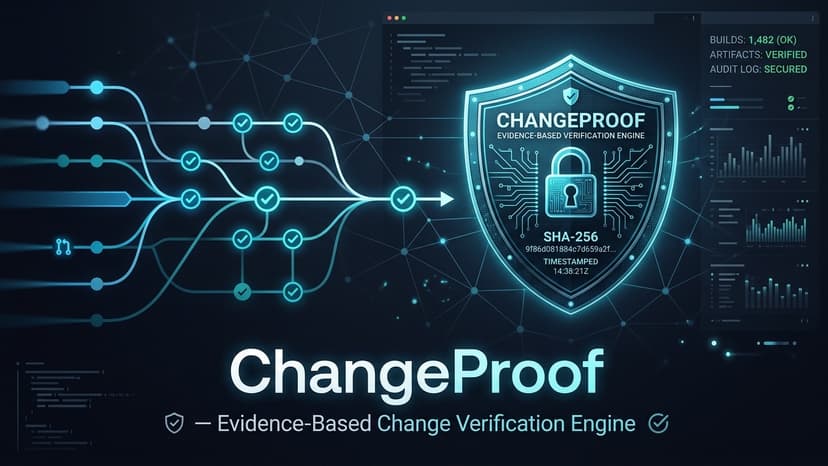
Software changes in microservices and distributed repositories frequently cause silent cross-system failures. While local tests on a feature branch pass, breaking API modifications, missing required fields, altered serialization formats, and stale client SDKs escape to staging or production. Release decisions today rely on subjective confidence, superficial PR reviews, and narrow unit test suites rather than comprehensive, evidence-based verification of the complete blast radius. ChangeProof transforms release governance by providing an evidence-based change verification authority. Designed for software engineers, tech leads, and release managers, ChangeProof automates the analysis, multi-dimensional verification, interactive remediation, and cryptographic evidence generation required before shipping code. When a change is submitted, ChangeProof parses the repository using real Tree-sitter AST grammars (Python, TypeScript, JavaScript) and constructs an in-memory NetworkX directed dependency graph. It calculates the exact transitive blast radius across API endpoints, downstream mobile/web consumers, schemas, and test suites in milliseconds. Eight parallel verifiers execute deterministically across the identified impact zone: 1. API Compatibility: Detects breaking schema changes, parameter additions, and type mutations. 2. Consumer Compatibility: Validates all downstream TypeScript and JavaScript client call sites against the updated signature. 3. Contract Verification: Checks OpenAPI and JSON schemas against handler declarations. 4. Test Execution: Runs affected test suites in isolated sandboxes to surface regression failures. 5. Schema Migration: Inspects database DDL for destructive locks and table rewrites. 6. Security Scanning: Flags hardcoded secrets, eval injection, and dangerous functions. 7. Documentation Consistency: Detects drift between code changes and API documentation. 8. Complexity & Linting: Guards code maintainability and style conformance. ChangeProof introduces an interactive Human-in-the-Loop Remediation Gate. When breaking changes or test regressions are detected, the system formulates bounded, non-breaking remediation patches (such as backwards-compatible default fallbacks and client call alignment). Crucially, no file is altered without explicit human approval. Upon approval, patches are applied to physical disk, and the verification suite automatically re-runs. Once all checks pass, ChangeProof evaluates a deterministic policy gate (no critical or high findings) and issues an authoritative release decision: BLOCKED or VERIFIED (READY FOR RELEASE). It then generates a tamper-evident evidence package sealed with a SHA-256 cryptographic digest. This package contains the full repository context, affected endpoints, verification results, approver signature, and remediation diffs, exportable as JSON or standalone HTML. ChangeProof eliminates guesswork from deployment, replacing unverified assumptions with deterministic proof.
27 Sep 2026
Adaptive AI Model Router
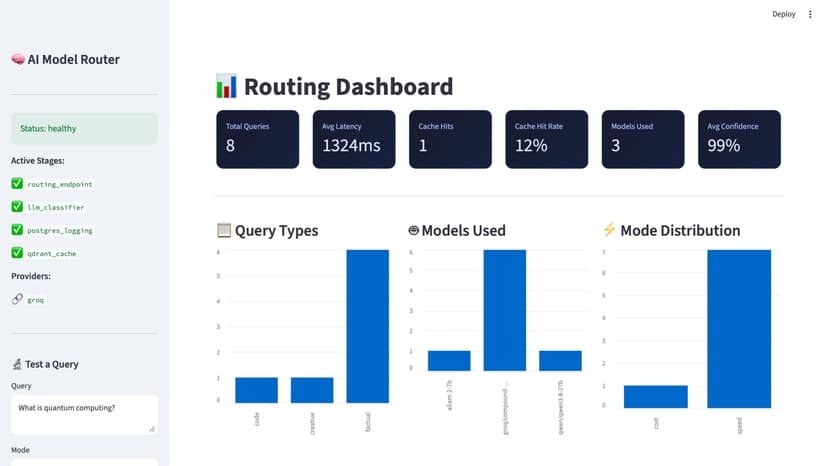
Adaptive AI Model Router solves a real problem in modern AI infrastructure: teams default to one expensive model for every request, wasting cost and latency on queries that don't need it. This project routes each incoming query intelligently instead. The system classifies each query (simple factual, reasoning-heavy, creative, or code) using a LangGraph decision pipeline, then routes it to the most suitable LLM based on a user-selected priority: Speed, Cost, or Quality. Groq powers fast inference for lightweight queries, with fallback providers available for heavier reasoning tasks. To avoid redundant classification work, the router checks Qdrant for semantically similar past queries and reuses proven routing decisions when a good match is found, cutting latency and cost further. Every request, classification, chosen model, and estimated cost is logged to PostgreSQL, and a live dashboard shows exactly which model handled each request and why — turning what's usually an invisible infra decision into something teams can observe and tune. Built solo with FastAPI, LangGraph, Groq, Qdrant, PostgreSQL, Redis, and Docker, the whole stack runs with a single docker-compose command, making it easy for any team to drop into their own infra and start saving on inference costs immediately.
16 Sep 2026


